
EDI Integration for Healthcare and Pharmaceuticals: What Compliance Actually Requires
Most healthcare and pharma EDI projects get scoped as a mapping exercise. Take the order from the wholesaler, turn it into something the ERP understands, send the invoice back. Two weeks of field mapping, a round of partner testing, done.
Then an auditor asks a different question: show me what you sent, when you sent it, what it contained, and prove nothing changed in between.
That gap between "the messages flow" and "we can evidence the messages" is where most findings come from. Here is what compliance actually asks for in a regulated supply chain, and what that means for how you build the integration.
Healthcare EDI is not one standard it's four overlapping ones
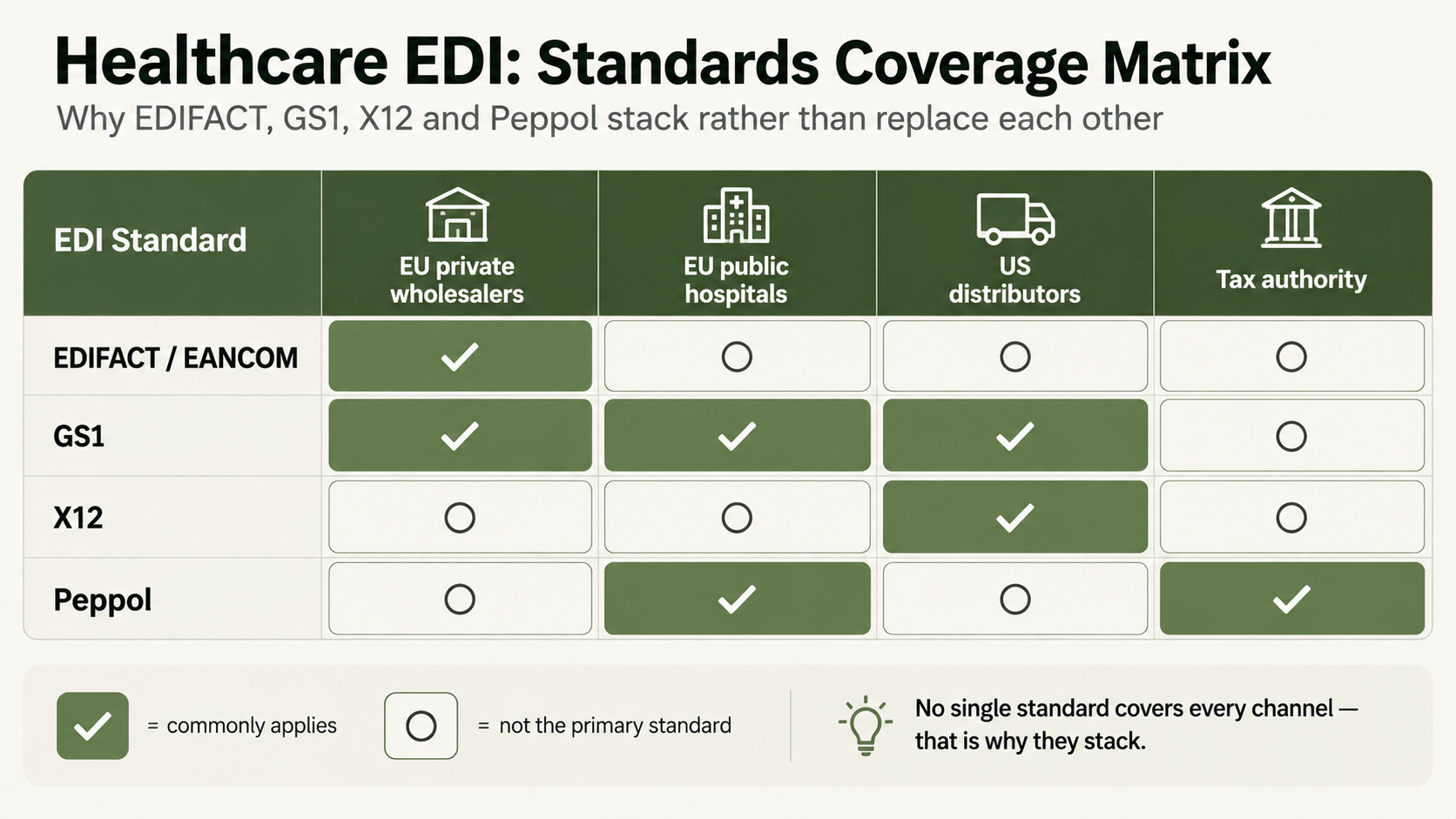
Anyone selling into hospitals, pharmacies and pharmaceutical wholesalers ends up supporting several standards at once. They don't replace each other. They stack.
EDIFACT and EANCOM in European supply chains
Most European hospital groups, pharmacy chains and pharma wholesalers run on UN/EDIFACT, usually through the EANCOM subset. ORDERS, ORDRSP, DESADV and INVOIC cover the bulk of the traffic. Every large buyer applies its own message implementation guideline on top, so "we support EDIFACT" rarely means "we support this customer."
GS1 identification rules
In pharma and medical devices, identification carries more weight than anywhere else. GTINs identify the product, GLNs identify the trading location, SSCCs identify the logistics unit. When a DESADV arrives with an SSCC that doesn't match what's on the pallet label, receiving stops. The message was technically valid. The data was wrong.
X12 and HIPAA transaction sets
X12 dominates North America, and HIPAA transaction sets cover claims, eligibility and remittance between providers and payers. A European supplier shipping product to a US distributor will meet X12 for commercial documents. That is a different world from HIPAA claims processing worth separating clearly before scoping anything.
Peppol and national e-invoicing mandates
Public hospital procurement across Europe runs on Peppol, and national B2B mandates are widening the requirement beyond the public sector. For a supplier already exchanging EDIFACT with private wholesalers, this means running two invoice channels in parallel. A certified Peppol Access Point handles the network side, but the mapping and validation work still has to sit somewhere.
What "compliance" actually means here
Traceability that survives the round trip
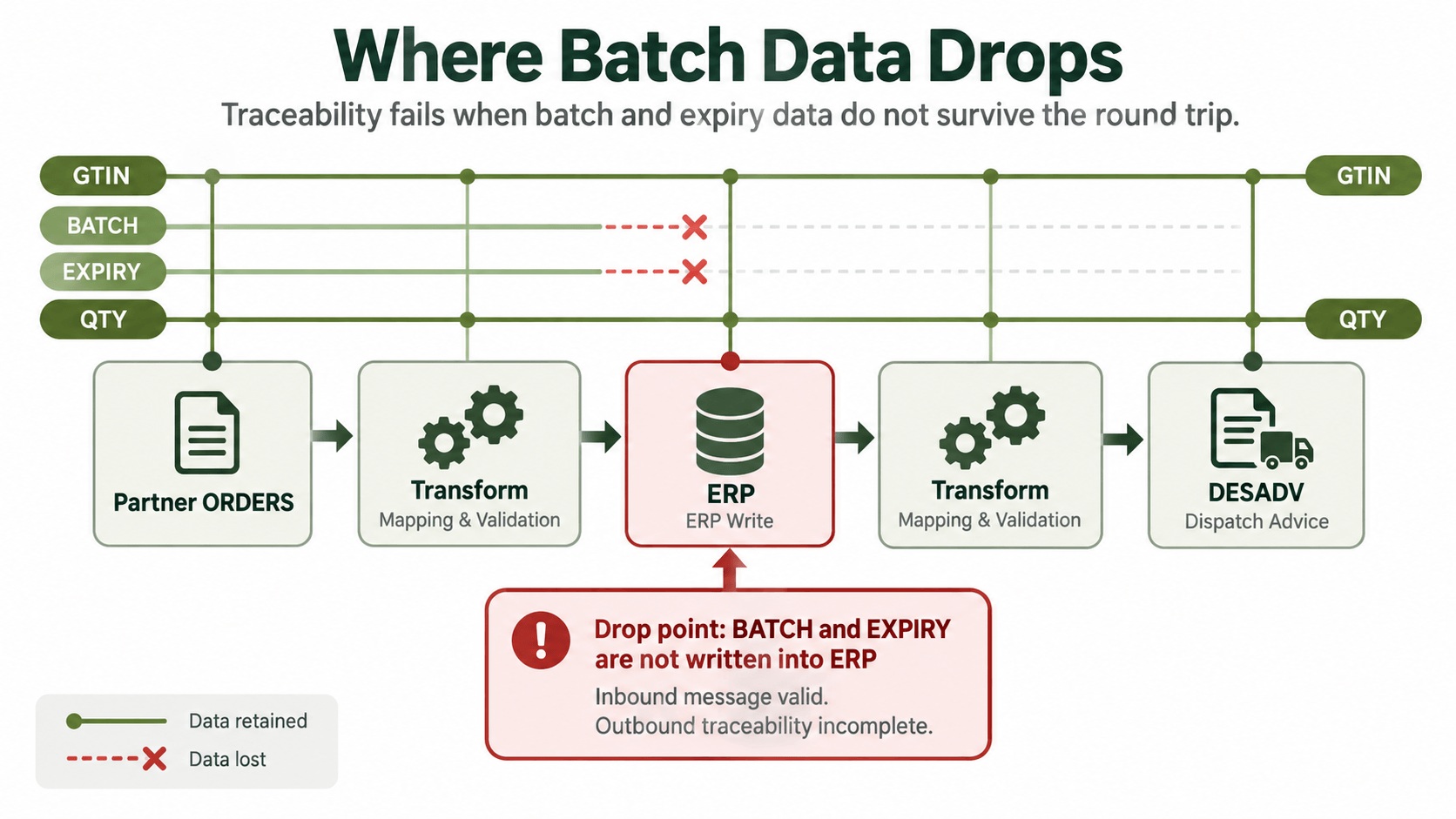
Batch number, expiry date and where serialisation applies the unique identifier have to reach the ERP intact and come back out on the dispatch advice and invoice. The common failure is undramatic: the ERP item master has no field for batch-level attributes, so the mapping quietly drops them. Documents keep flowing. Traceability doesn't.
If your products fall under the EU Falsified Medicines Directive framework, serialisation data is managed through a separate repository system, not through EDI. But the batch and expiry data in your DESADV still has to agree with it.
Audit trail and retention
Auditors want the message as sent, the timestamp, the acknowledgement, the validation result, and the history of any reprocessing. "We reran the file" is not evidence. "Here is version one, here is why it failed, here is version two, here is who authorised the resend" is.
Validated systems and change control
If you operate under GxP, your computerised systems are expected to be qualified and changes controlled EU GMP Annex 11 is the usual reference point. Integration middleware sits inside that scope more often than project teams assume. A mapping change pushed to production without a change record is a finding waiting to happen.
GDPR in a commercial flow
Order and invoice traffic is commercial data. Direct-to-patient dispatch, home delivery and some returns flows are not they carry names and addresses. That changes your lawful basis, your retention rules and your processing records. Worth identifying before go-live, not after.
The five failures that show up in audits
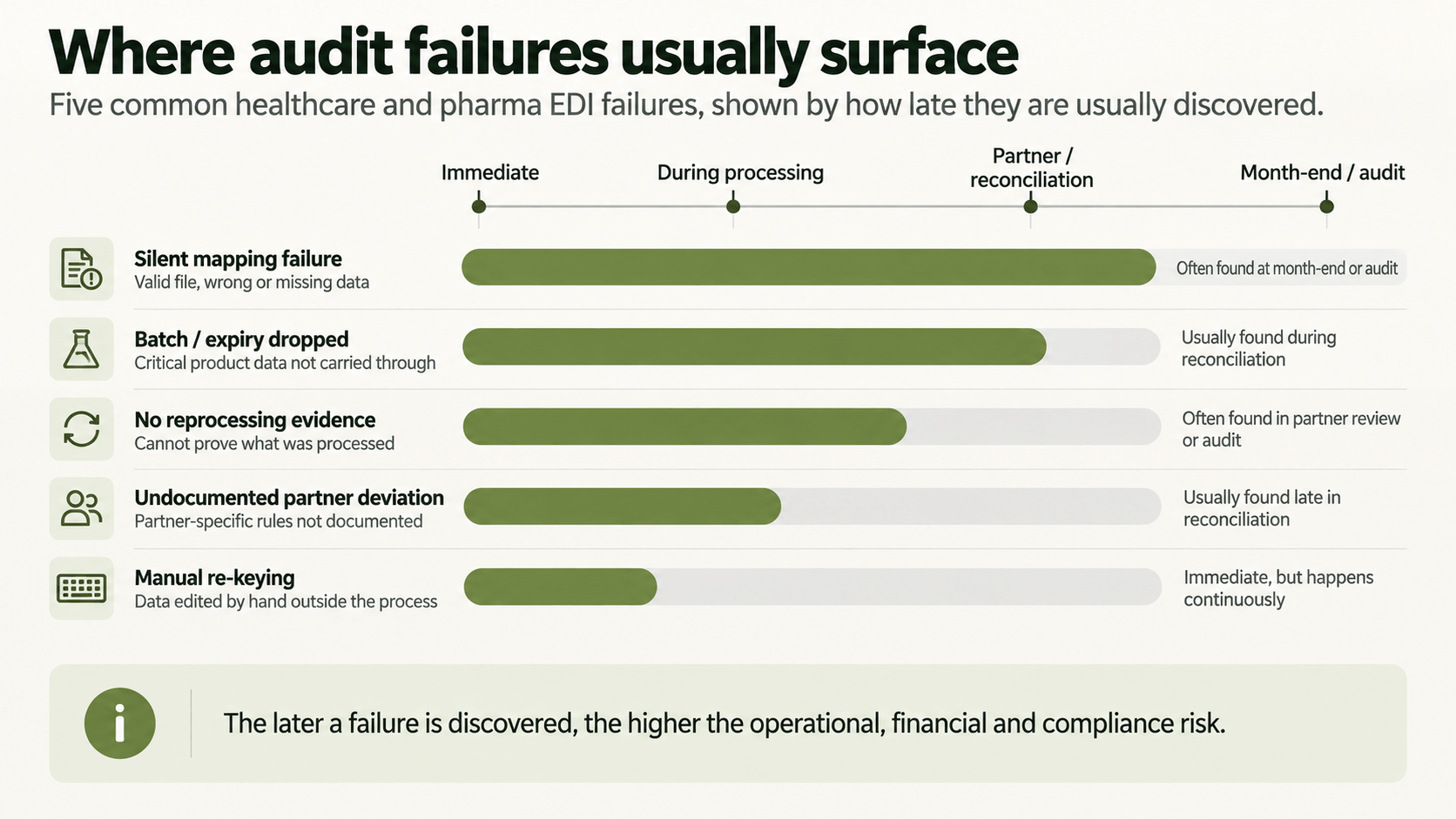
Silent mapping failures. A field is unmapped, the document passes structural validation, and the gap surfaces at month-end.
Batch and expiry dropped in transformation. Present inbound, absent in the ERP, absent again outbound.
No reprocessing evidence. Files were fixed and resent, with nothing recording what changed.
Undocumented partner deviations. A customer-specific tweak lives in one consultant's head.
Manual re-keying between EDI and ERP. Every manual touch is an uncontrolled step in a controlled process.
What a defensible integration layer looks like
Validation runs on inbound documents before anything writes to the ERP, and on outbound documents before they reach the partner structure, mandatory fields, and the business rules that matter in your sector, including batch and expiry presence.
Every message is logged at document level with status, validation result and full history, so replay is a recorded action rather than a manual rerun. Partner onboarding happens through configuration and reusable profiles rather than code changes, which keeps new customers out of your change-control backlog.
And it sits on top of the ERP you already run. EDI integration that replaces your ERP turns a two-month project into a two-year one, and validation scope grows with it.
FAQ
Is EDI mandatory in healthcare? Not as a general legal requirement in Europe. It becomes mandatory commercially most large hospital groups and pharma wholesalers won't onboard a supplier without it. E-invoicing is a separate question, and there the obligation is statutory in a growing number of countries.
What's the difference between EDI and an e-invoicing mandate? EDI is the commercial exchange of business documents with trading partners. An e-invoicing mandate is a tax-authority requirement covering invoice format, transmission route and sometimes reporting. You can be fully EDI-enabled and still non-compliant with a national mandate.
Does HIPAA apply to a European supplier? Generally not to commercial order and invoice traffic. HIPAA covers protected health information in payer and provider transactions. A European manufacturer shipping to a US distributor is in X12 territory, not HIPAA territory. Confirm with counsel for your specific flows.
Can EDI carry serialisation data? Serialisation under the EU FMD framework runs through a dedicated repository system, separate from EDI. EDI messages carry batch, expiry and quantity and those have to reconcile with what the repository holds.
How long do we need to retain EDI records? Retention is driven by national accounting and tax law plus any sector-specific requirement, not by the EDI standard. Check your own jurisdictions the periods differ, and the longest one governs.
How long does trading partner onboarding take? It depends on how much of the work is configuration and how much is development. Where mappings and partner profiles are reusable, each new partner should take less time than the last.
Where to start
If you're carrying EDI flows into a regulated supply chain and you're not certain you could evidence them under audit, the useful first step is a look at what you actually have: which flows run, where validation happens, what gets logged, and where data drops between systems.
Our team works with manufacturers and distributors across Europe on exactly this see ERP integration services, or get in touch for a look at your current setup.