
Over EUR 800,000 in 2026? Your German B2B Invoices Must Be E-Invoices From 1 January 2027
Eight weeks to go, and your 2026 numbers decide it
On 1 January 2027, Germany's e-invoicing mandate takes its next step. Businesses whose turnover crossed EUR 800,000 in 2026 must issue structured e-invoices for domestic B2B sales. Everyone else gets one more year.
The test year is the one closing now. If your German entity sits anywhere near the line, the finance team needs a reliable 2026 projection this month, not after the year-end close.
This guide explains how the Germany e-invoicing 800,000 threshold works, where CFOs misread it, and what to put in place before January.
This article is a general overview for planning purposes, not tax advice. Confirm your position with your Steuerberater.
What the EUR 800,000 test actually measures
The rule sits in § 27 Abs. 38 UStG, the transitional provision introduced by the Wachstumschancengesetz. Three details decide whether you are in scope. For the full timeline, see our Germany e-invoicing country guide.
It is your Gesamtumsatz, not your B2B revenue
The threshold uses the Gesamtumsatz as defined in § 19 UStG. Broadly, that is the total of the business's supplies under German VAT law, less certain VAT-exempt supplies. It is not limited to domestic or B2B sales. B2C and export revenue count towards the figure too.
The Gesamtumsatz can also differ from revenue in your P&L or annual accounts. Do not take the figure from the management report without a VAT-based check.
It is the issuer's turnover, not your customer's
The test applies to the business issuing the invoice. A small supplier invoicing a large German customer still uses its own turnover. A large supplier invoicing a small customer is in scope from 2027.
It is last year's figure
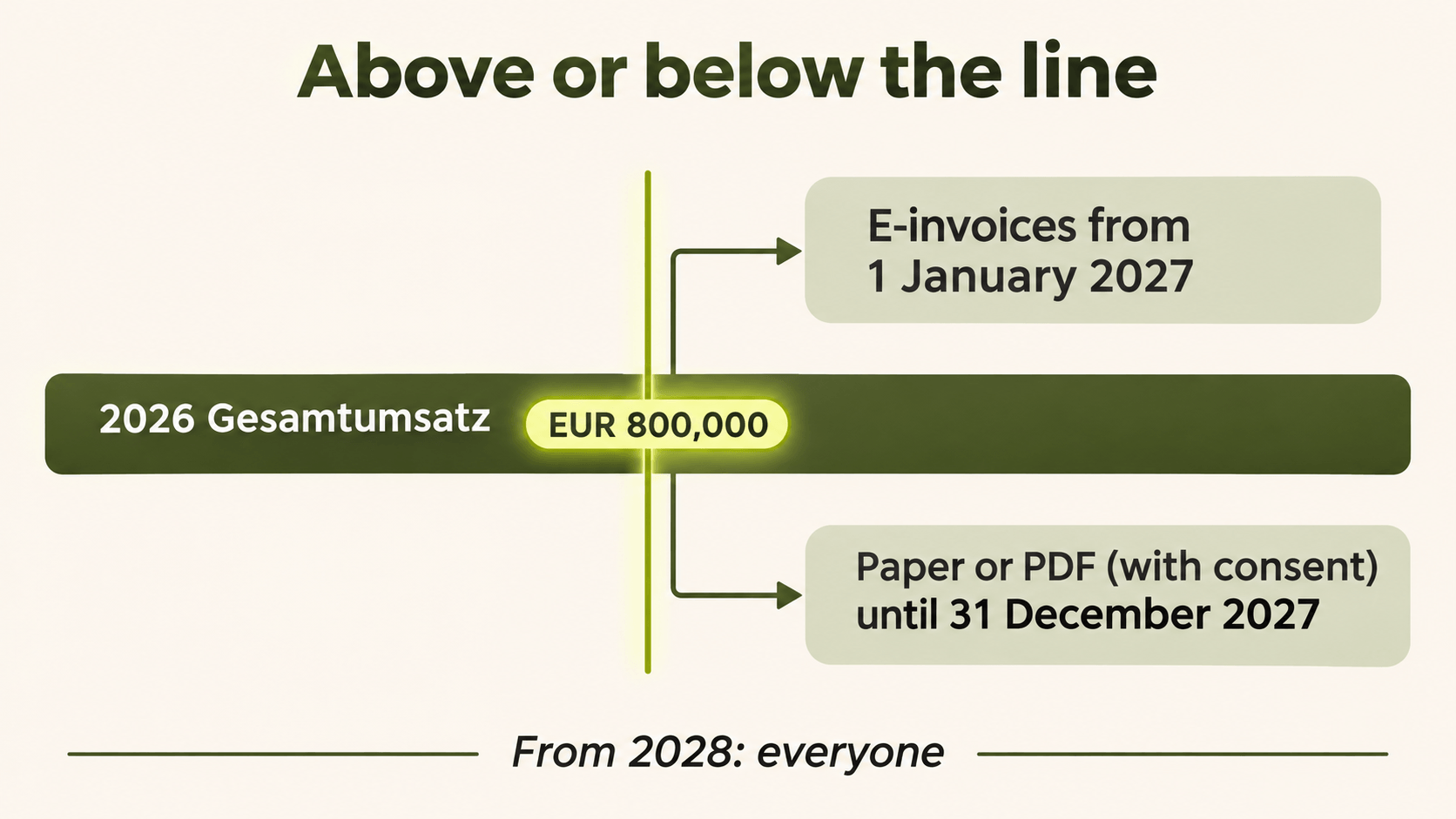
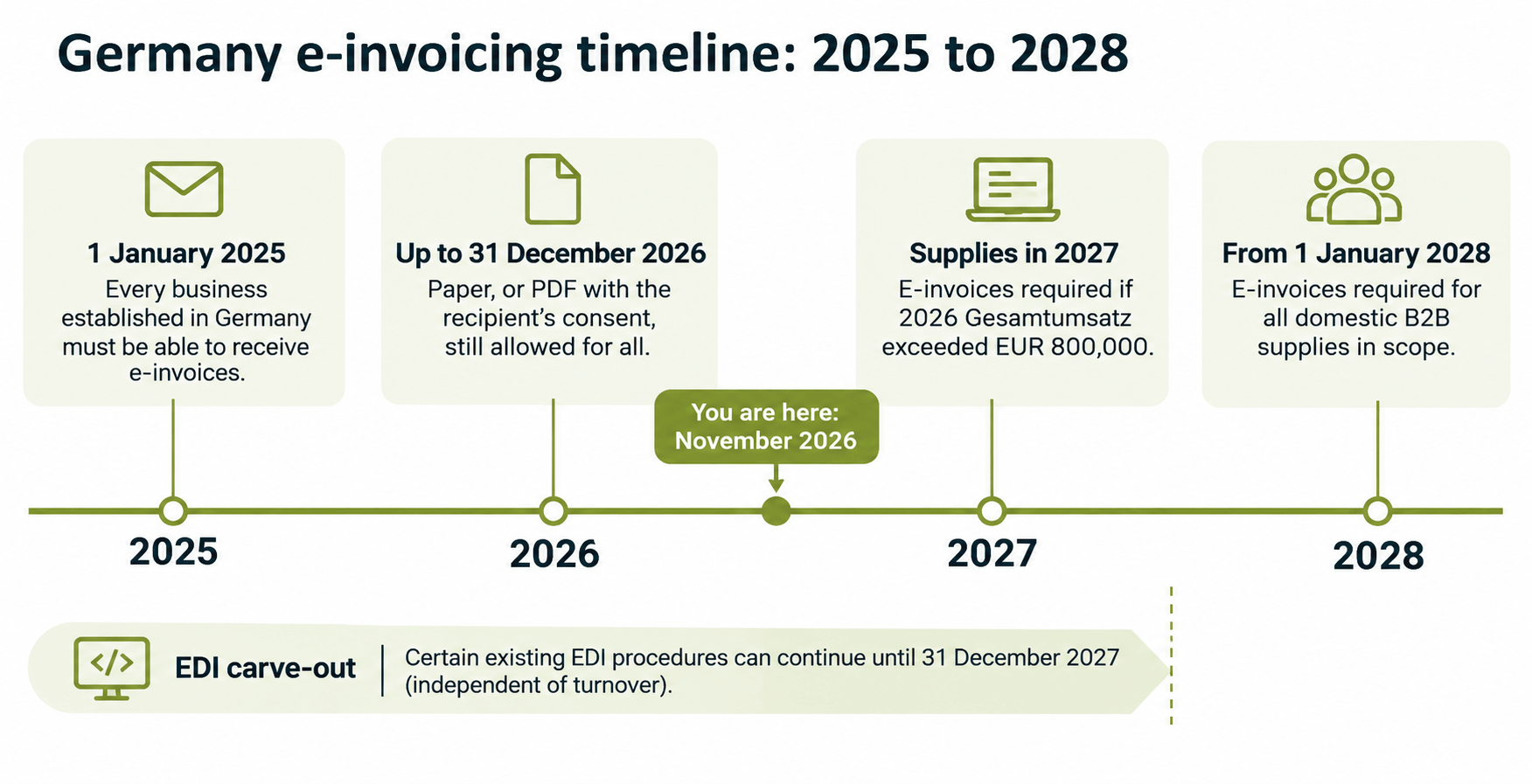
For supplies made in 2027, the relevant year is 2026. Turnover above EUR 800,000 in 2026 means e-invoices from 1 January 2027. EUR 800,000 or less means paper or, with the customer's consent, PDF invoices remain possible until 31 December 2027. From 1 January 2028, the threshold falls away and every business in scope must issue e-invoices.
The timeline in one view
Three details CFOs get wrong
The supply date matters, not the invoice date
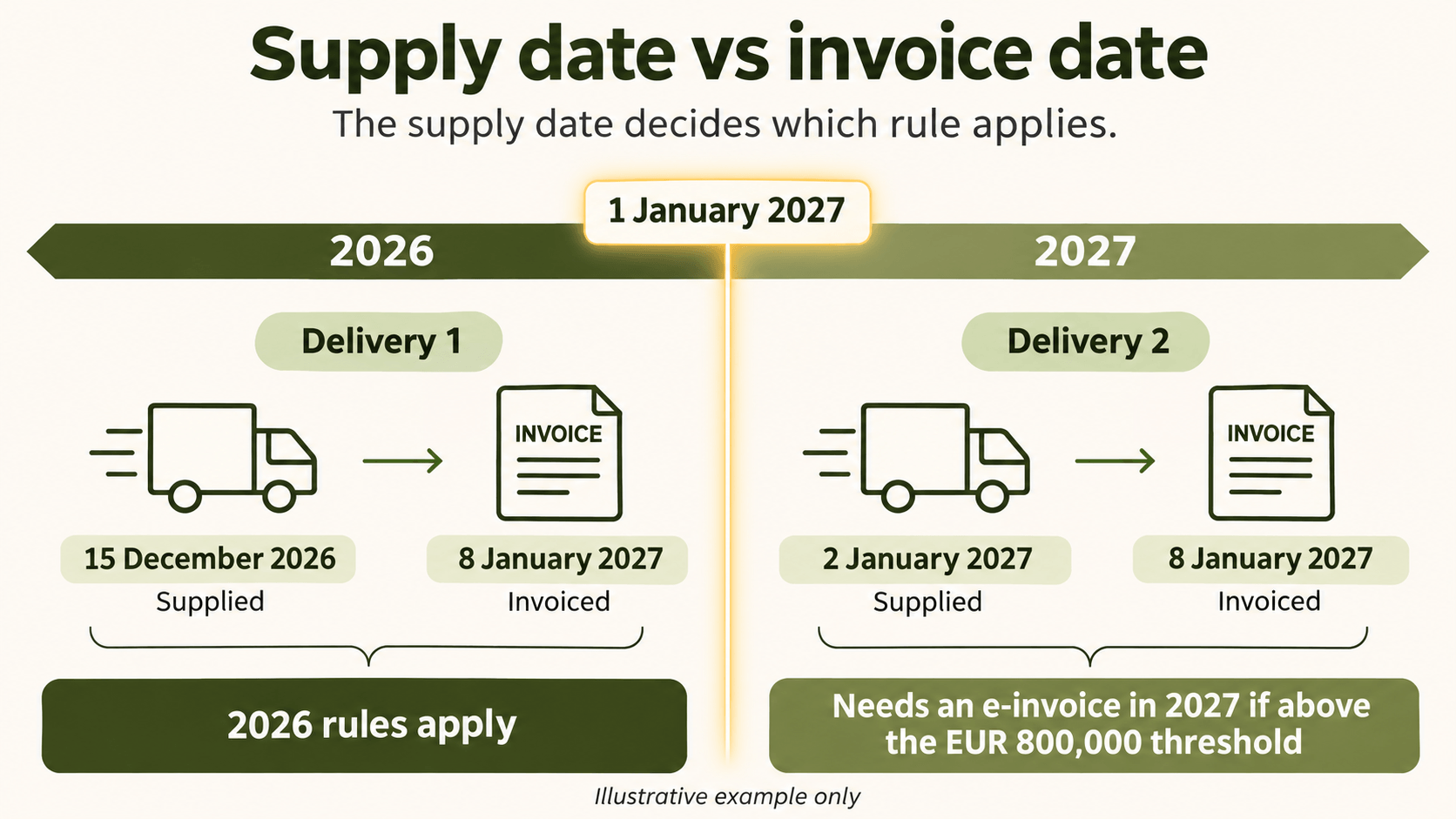
The transitional rules follow the date the goods or services were supplied, not the date on the invoice. A delivery made in December 2026 and invoiced in January 2027 still falls under the 2026 rules. A delivery made on 2 January 2027 by a business above the threshold needs an e-invoice, whenever it is billed.
Plan cut-off procedures with this in mind, especially for long-running services and partial deliveries.
The EDI carve-out has its own clock
Many larger businesses already exchange invoices with key customers through EDI, often in EDIFACT or partner-specific formats. Where an EDI procedure does not yet meet the e-invoice requirements, a separate transitional rule in § 27 Abs. 38 UStG lets it continue until the end of 2027, independent of turnover.
That buys time, not an exemption. EDI flows need to deliver invoice content that can be extracted in a form meeting EN 16931 by 2028. Review your EDI integration flows in 2027, not late 2027.
Group entities are tested one by one
The test applies per business (Unternehmer), not per group. A Nordic parent with two German subsidiaries may find one in scope from 2027 and the other from 2028. Where a VAT group (Organschaft) exists, the calculation basis can change, so check how your structure is treated.
The obligation covers domestic B2B supplies between businesses established in Germany. A foreign company with only a German VAT registration and no establishment there is generally outside the issuing obligation, while its German subsidiary is not.
A year-end checklist for the finance team
With eight weeks left, focus on decisions rather than projects:
Project the 2026 Gesamtumsatz for each German entity on a VAT basis, with your tax adviser.
List the entities that issue domestic B2B invoices and flag which cross the threshold.
Check what your ERP can output. German buyers will expect XRechnung or ZUGFeRD (EN 16931 profile or higher). A formatted PDF is not an e-invoice. Our article on what SAP Business One needs before January 2027 shows the typical gaps.
Clean master data. Missing VAT IDs, non-standard unit codes and free-text payment terms are the usual causes of validation failures.
Agree formats and channels with your largest customers. Germany has no central platform, so delivery is agreed between the parties: email, Peppol, EDI or a portal.
Confirm archiving. The structured file is the original and must be retained in that form under GoBD.
Meeting the mandate without replacing your ERP
The 2027 deadline is a format and process change, not a reason to change your ERP. Your ERP stays the system of record for invoices. Format conversion, validation and delivery can sit in an integration layer on top of it.
That is how HubBroker works. HubBroker iPaaS takes invoice data from Microsoft Dynamics 365 Business Central, Microsoft Dynamics 365 Finance & Operations, SAP Business One and other ERPs, maps it to XRechnung or ZUGFeRD, validates it against EN 16931, and delivers it through the channel each customer uses. Inbound invoices come back as structured data ready to post. Read more about our e-invoicing solution.
Frequently asked questions
Does turnover outside Germany count towards the EUR 800,000?
The test uses the Gesamtumsatz under § 19 UStG, which is not limited to domestic B2B sales. How specific cross-border and exempt supplies are treated should be confirmed with your tax adviser.
Can we still send PDF invoices in 2027?
Only if your 2026 Gesamtumsatz was EUR 800,000 or less, and only with the customer's consent. Above the threshold, domestic B2B invoices for 2027 supplies must be e-invoices, unless the EDI transitional rule applies.
We expect to land just around EUR 800,000. What should we do?
Prepare as if you are in scope. The final 2026 figure will only be certain after the year-end close, when January invoices are already going out.
Does the mandate apply to foreign suppliers invoicing German customers?
The issuing obligation applies to domestic supplies between businesses established in Germany. A foreign supplier without a German establishment is generally outside it. If you have a German subsidiary or fixed establishment, check its position separately.
Do small businesses under the Kleinunternehmer regime have to issue e-invoices?
No. Kleinunternehmer are exempt from the issuing obligation, but like all businesses established in Germany they must be able to receive e-invoices.
What happens to EDI after 2027?
EDI remains a valid channel. From 2028, the invoice content must be extractable in a format that meets EN 16931 or is interoperable with it.
Check your German invoice flows before January
If you are unsure whether your German entities are in scope, or whether your ERP output would pass EN 16931 validation, our team can review your outbound invoice flows with you. Book a demo to see how HubBroker iPaaS connects your ERP to German e-invoicing without a system change.
