

Selling Into Germany From the Nordics: Are You In Scope for the 2027 Mandate?
A finance director in Copenhagen, Stockholm or Oslo hears "Germany, 1 January 2027" and assumes their company has a deadline. Many do not. For most Nordic suppliers, the German rules on e-invoicing for foreign companies turn on one test, and it isn't turnover or VAT registration. It is where your business is established.
Getting this wrong costs money in both directions. Some companies will over-invest in a rushed German compliance project they don't legally need. Others will assume they are exempt when a German subsidiary or branch puts them in scope. This article walks through the test, three common Nordic scenarios, and what changes even when the mandate doesn't apply to you.
What Germany's 2027 Mandate Actually Requires
Germany introduced mandatory B2B e-invoicing through the Wachstumschancengesetz (Growth Opportunities Act). Under the new rules, an e-invoice must be structured data that meets the European standard EN 16931. A PDF sent by email no longer counts, even though it is digital.
Receiving since 2025, issuing from 2027 and 2028
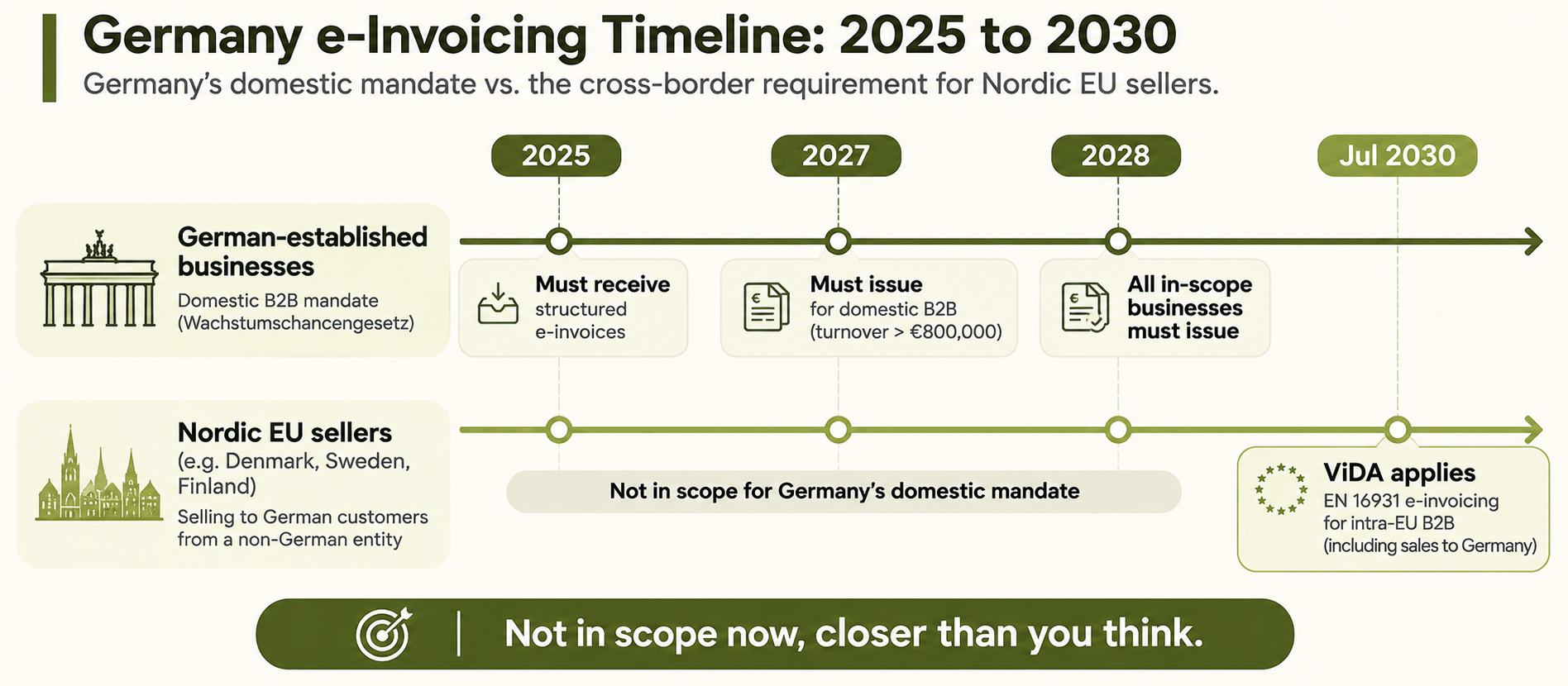
The rollout runs in three steps:
1 January 2025: every business established in Germany must be able to receive structured e-invoices.
1 January 2027: businesses with prior-year turnover above €800,000 must issue them for domestic B2B sales.
1 January 2028: the transition ends and all remaining in-scope businesses must issue them.
Our Germany e-invoicing country guide covers the formats and timeline in more detail.
The €800,000 threshold and who it applies to
The threshold decides when an in-scope business must start issuing. It does not decide whether a business is in scope. That question comes first, and for foreign companies it usually settles the matter before turnover is even considered.
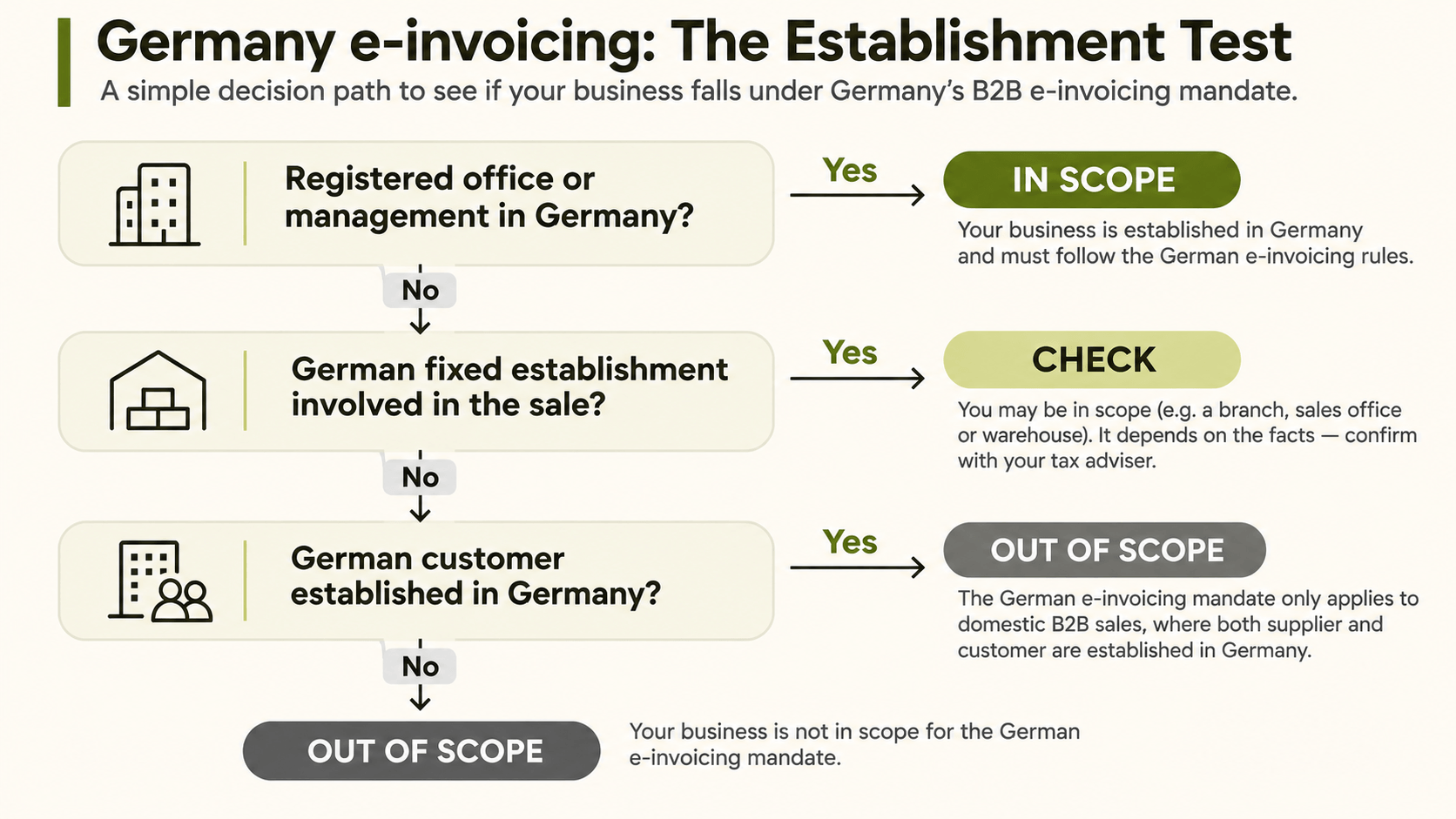
Germany E-Invoicing for Foreign Companies: The Establishment Test
The issuing obligation applies to domestic B2B transactions where both the supplier and the customer are established in Germany. "Established" means a registered office, place of management, or a fixed establishment (feste Niederlassung) in Germany that is involved in the transaction.
Why a German VAT registration isn't enough
Many Nordic companies hold a German VAT number. They may hold stock in Germany, sell to German customers, or handle distance sales. A VAT registration on its own does not make you established. The German Ministry of Finance (BMF) guidance treats VAT-registered but non-established businesses as outside the issuing obligation.
When a German subsidiary or fixed establishment changes the answer
The picture changes if you have a real presence in Germany. A German GmbH is a German business in its own right and is fully in scope. A fixed establishment, such as a branch with its own staff and resources, puts you in scope when it is involved in the sale.
Marking non-established status on your invoices
In its November 2025 FAQ update, the BMF said that VAT-registered businesses without a German establishment may note that status on their invoices. This is a small step. It helps German customers' AP teams understand why they are receiving a PDF rather than XML.
Three Nordic Seller Scenarios
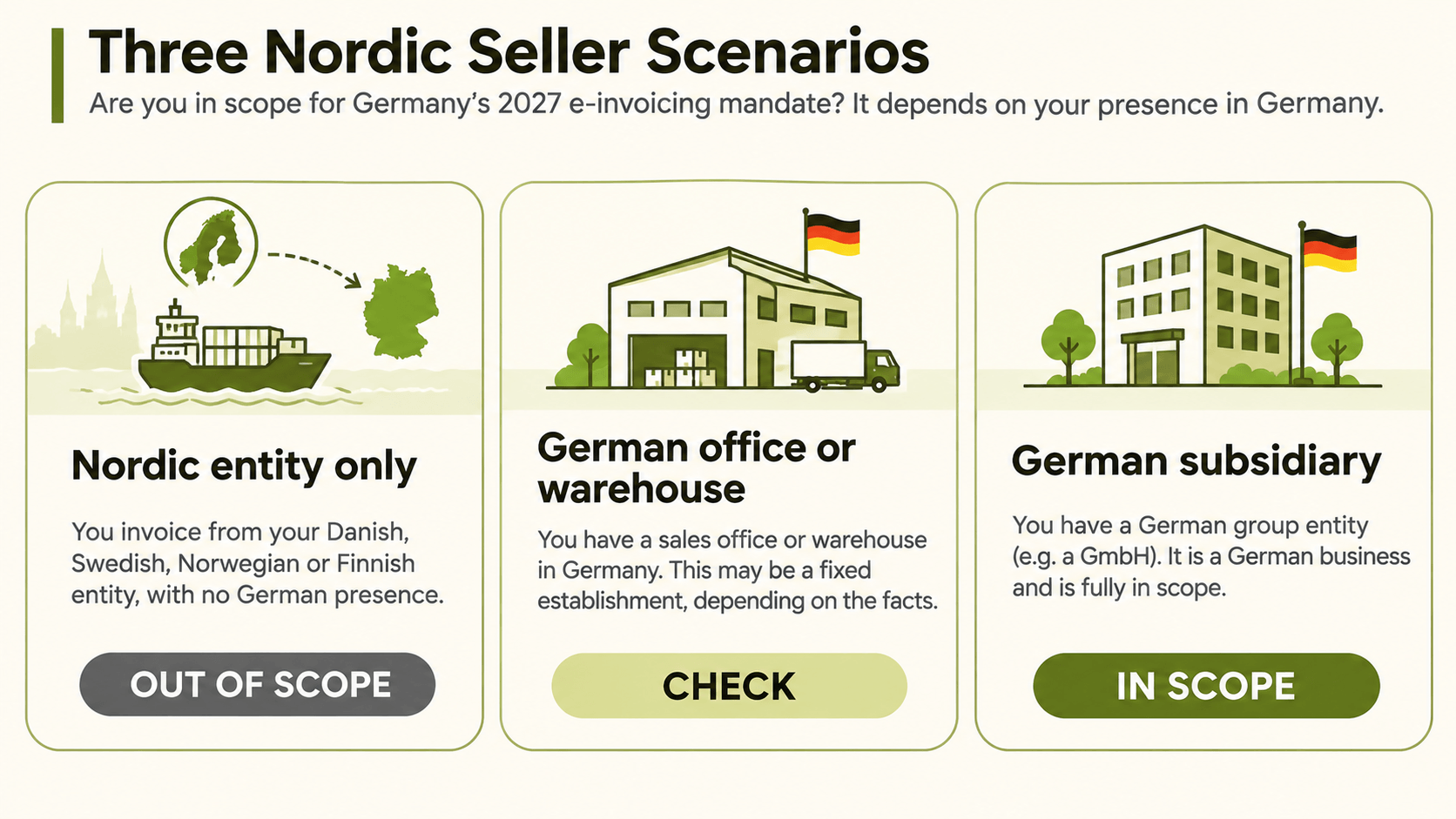
Shipping from the Nordics with no German presence
You invoice from your Danish, Swedish, Norwegian or Finnish entity, and goods ship from your home warehouse. You are outside the German issuing obligation. You can continue to invoice German customers in your current format, unless your contract says otherwise.
A German sales office or warehouse
This is the grey zone. A sales office with employees who negotiate and close deals may well be a fixed establishment. A warehouse is less clear. The outcome depends on facts such as personnel and technical resources, and on whether that location takes part in the supply. Put this question to your tax adviser before January, not after.
A German group entity that buys from you or sells for you
If your group has a German subsidiary, that entity has been obliged to receive e-invoices since 2025. Depending on its turnover, it must also issue them from 2027 or 2028. Your intercompany invoices to it may fall outside the mandate. Its own sales to German customers do not. If the subsidiary runs its own ERP instance, check whether that system can actually produce XRechnung. Our article on SAP Business One and German e-invoicing shows the typical gaps.
Out of Scope Doesn't Mean Unaffected
German buyers will prefer structured invoices anyway
Every German business customer is now set up to receive structured e-invoices. As their own issuing deadlines arrive, AP teams will push suppliers toward XRechnung or ZUGFeRD so that everything flows into one automated process. The law may not require you to change, but your customers' procurement terms might.
Your home market has its own timeline
Norway's B2B mandate starts on 1 January 2027. You can read about it in our post on e-invoicing in Norway 2027. Denmark, Sweden and Finland have no general B2B mandate today, but Peppol is widely used across all four countries. A Peppol connection you set up for one market often serves the others.
ViDA and cross-border e-invoicing from 2030
From 1 July 2030, the EU's VAT in the Digital Age (ViDA) package makes structured EN 16931 e-invoicing mandatory for intra-EU B2B transactions. For Danish, Swedish and Finnish sellers, invoices to German customers will move to structured formats by then regardless of the German rules. Norway is outside the EU VAT system, so Norwegian sellers should confirm separately how ViDA affects them.
A Five-Point Checklist for Your Finance Team
Map your German footprint. List every German entity, branch, office and warehouse, and which entity issues each invoice.
Get a written establishment view. Ask your tax adviser to confirm your status, especially where you have a German warehouse or staff.
Check German group entities separately. Confirm their turnover against the €800,000 threshold and whether their ERP can produce XRechnung or ZUGFeRD.
Ask your top German customers what they want. Their format preference may matter more than the legal minimum.
Test your output. Run a sample invoice through a free XML and e-invoice validator to see whether your current data would pass EN 16931 checks.
FAQ
Do foreign companies have to issue e-invoices in Germany from 2027?
Generally not. The obligation applies when both supplier and customer are established in Germany. A foreign company without a German establishment is outside the issuing obligation.
Does a German VAT number put us in scope?
No. VAT registration alone does not make a company established in Germany. A registered office, place of management, or fixed establishment involved in the transaction does.
Can we keep sending PDF invoices to German customers?
If you are not established in Germany, the German mandate does not require you to stop. Check your customer contracts, and plan for ViDA in 2030 if you invoice from an EU entity.
Which formats do German buyers accept?
XRechnung and ZUGFeRD (from version 2.0.1, EN 16931 profile or higher) are the main formats. Other EN 16931-compliant formats are possible if both parties agree.
Does the €800,000 threshold apply to non-established companies?
The threshold only matters once a business is in scope. It sets the issuing date for German-established businesses. Group structures and partial years need adviser input.
Is this article tax advice?
No. It is a general overview. Confirm your position with a qualified German tax adviser.
Know Your Position Before January
For most Nordic suppliers, the honest answer is "not in scope today, but closer than you think." HubBroker sits on top of your existing ERP and adds XRechnung, ZUGFeRD and Peppol output where you need it, without replacing your ERP. When you are ready to plan your German and cross-border invoicing, our e-invoicing solution is a good place to start.
Not Sure Where Your Company Stands?
In a 30-minute call, we'll map your German entities, customers and invoice flows, and show you what structured e-invoicing would look like on top of the ERP you run today. No ERP change, no obligation.
