

France, Germany, Poland: Three E-Invoicing Mandates, Three Architectures, One Finance Problem
If your group invoices customers in Paris, Berlin and Warsaw, you may assume one compliant e-invoicing setup covers all three. It doesn’t. Comparing France, Germany and Poland shows the deadlines are only part of the gap. Each country has chosen a different architecture for how an invoice travels, who validates it, and when it becomes legally valid.
For a CFO, that architecture decides the real work: which systems change, where cash-collection risk moves, and how many processes your AP and AR teams have to run.
France, Germany and Poland E-Invoicing Compared: Why Architecture Matters More Than Deadlines
Centralised, decentralised, hybrid: the three models in plain terms
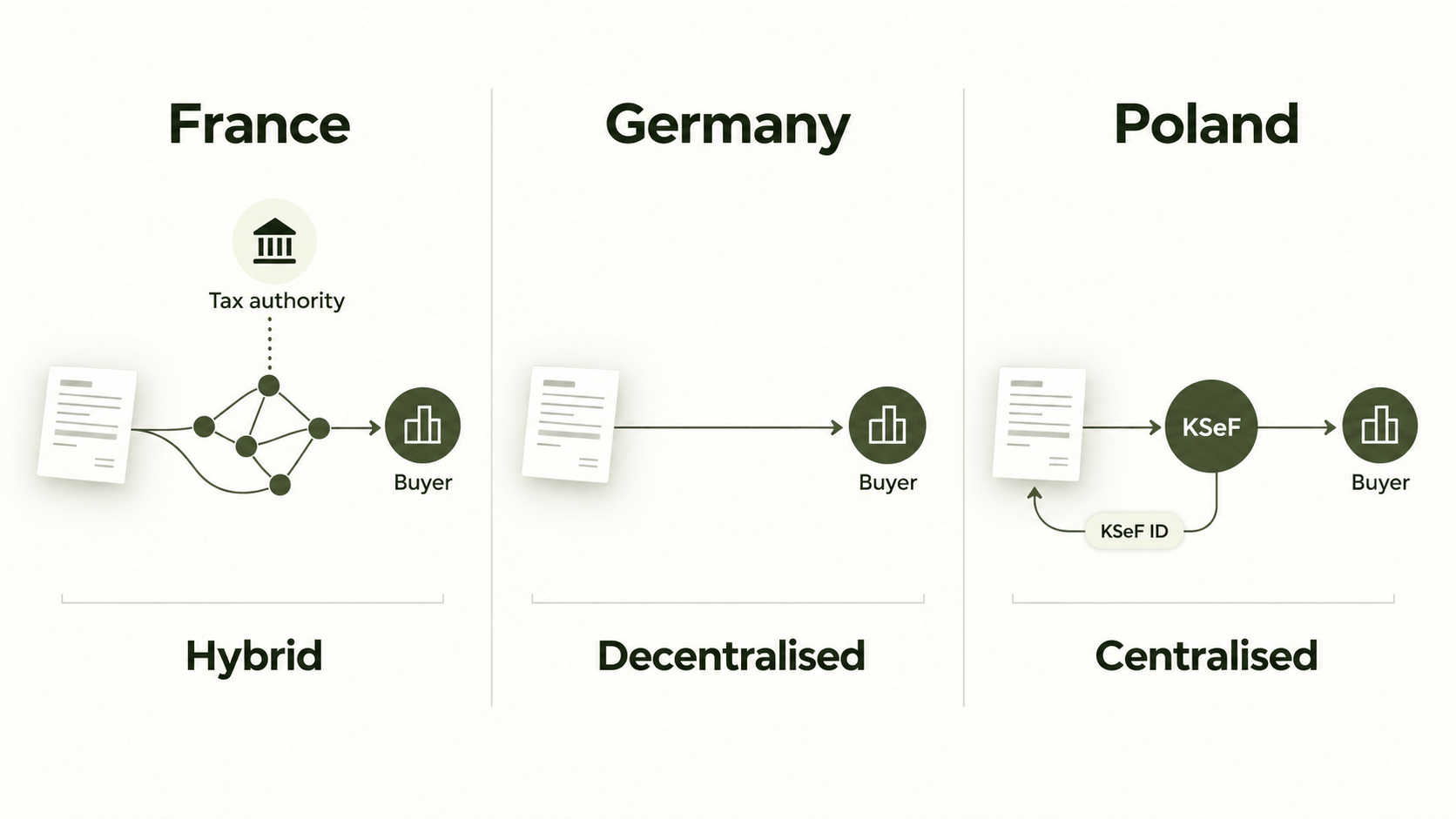
Poland is centralised. Every in-scope invoice passes through one government platform, KSeF, before it exists legally.
Germany is decentralised. Businesses exchange structured invoices directly, through any channel, with no central platform in the middle.
France is hybrid. Invoices flow between certified private platforms, and the tax authority receives data from them.
What “architecture” means for your AP and AR teams
Architecture determines three things your finance team will feel:
where an invoice can be rejected,
who holds the evidence of delivery, and
how quickly you know a customer has received it.
A deadline tells you when to act. The architecture tells you what to build.
France: Certified Platforms and Lifecycle Statuses
How the model works
France routes B2B invoices through certified platforms (Plateformes Agréées). A central directory tells senders which platform each buyer uses. Alongside the invoices, businesses report transaction and payment data to the tax authority (e-reporting), which covers B2C and international sales too.
Timeline and who is in scope
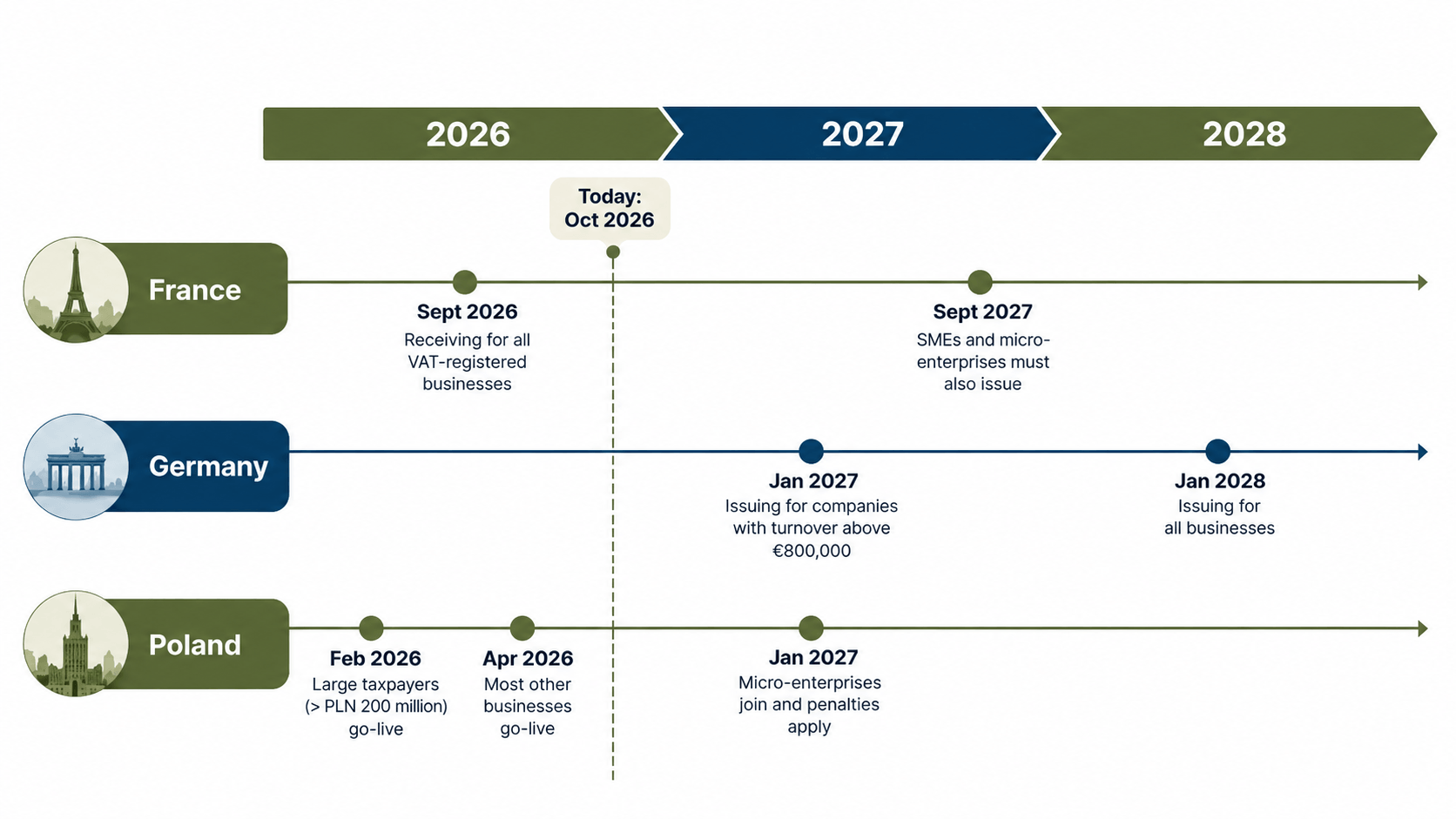
The reform is live. Every VAT-registered business in France must now be able to receive electronic invoices, and large and mid-sized companies must also issue them. Small businesses and micro-enterprises follow on 1 September 2027.
CFO impact
France adds mandatory lifecycle statuses: received, approved, disputed, paid. Your AR team gains visibility into where each invoice stands. Your AP team takes on new obligations to report those statuses back. Payment status in particular links invoicing directly to cash management.
Germany: Structured Formats Without a Central Platform
XRechnung, ZUGFeRD and EN 16931
Germany requires invoices that follow the European standard EN 16931. In practice, that means XRechnung (pure XML) or ZUGFeRD (a PDF with embedded XML). A plain PDF no longer qualifies as an e-invoice for domestic B2B.
Phased obligations and the turnover threshold
Every business in Germany must already be able to receive structured e-invoices. The obligation to issue them comes in two steps:
1 January 2027 for companies with prior-year turnover above €800,000.
1 January 2028 for everyone else.
CFO impact
There is no central portal to connect to. The work sits in your ERP’s master data and output formats. Many ERPs don’t produce XRechnung out of the box; our guide to SAP Business One and German e-invoicing covers the typical gaps. See the Germany e-invoicing overview for scope details.
Poland: KSeF as the Central Clearance Point
How clearance changes the invoice’s legal status
In Poland, an invoice is issued when KSeF accepts it and assigns a KSeF number. Anything sent outside the system does not count as a compliant invoice. This is the most significant difference from France and Germany.
Timeline
The rollout is phased:
1 February 2026: large taxpayers with 2024 sales above PLN 200 million, including VAT, began issuing through KSeF. From the same date, all businesses must receive invoices through KSeF.
1 April 2026: most other businesses followed.
1 January 2027: micro-enterprises join.
Penalties under Article 106ni of the VAT Act apply only from 1 January 2027. That means 2026 is effectively a grace period that ends in under three months.
CFO impact
Plan for:
Outages. Offline invoices must reach KSeF by the next business day.
Payment references. The requirement to include the KSeF number in payment references is also deferred to 2027, but it remains in place.
Foreign group entities that sell into Poland, which need a clear process.
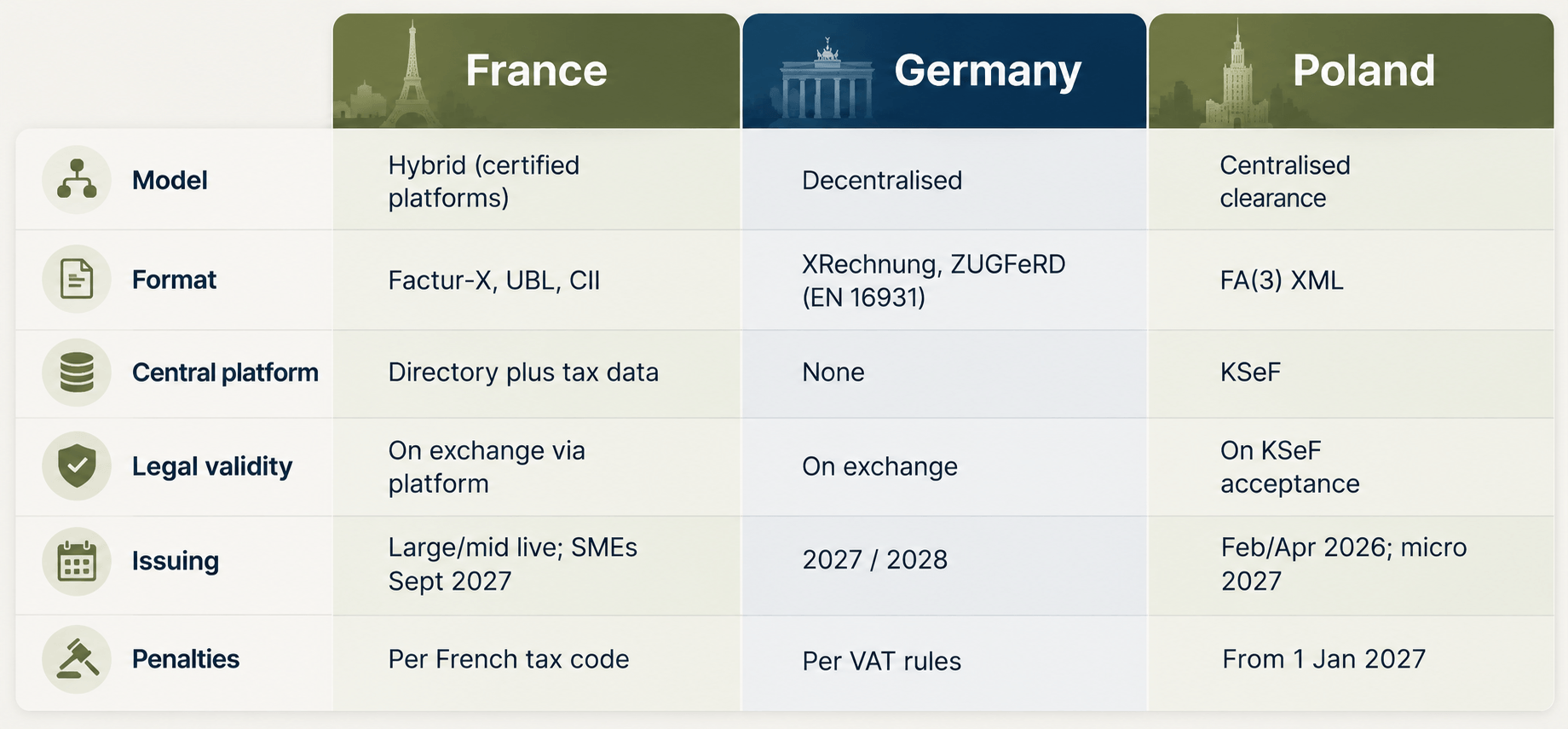
Side by Side: Three Mandates at a Glance
What This Means for a Multi-Country Finance Function
One ERP, three output channels
One sales invoice in your ERP now needs three different outputs:
a platform-routed file with statuses for France,
a structured format for Germany, and
a cleared XML with a returned ID for Poland.
Building each one inside the ERP means three projects and three sets of maintenance whenever a format changes.
An integration layer instead of three rebuilds
An integration layer sits between your ERP and each country’s channel. It handles mapping, validation, routing and status feedback without replacing your ERP. HubBroker’s e-invoicing service and ERP integration services work this way, connecting systems such as Dynamics 365 Business Central to each mandate’s requirements.
FAQ
Can one e-invoicing setup cover all three countries?
One integration layer can. One file format cannot, because each country requires different formats and channels.
Is Peppol enough for Germany?
Peppol can carry XRechnung. Germany doesn’t require a specific network, only a compliant structured format.
Are PDF invoices still allowed?
Plain PDFs are no longer compliant for in-scope domestic B2B in any of the three countries. Hybrid formats such as ZUGFeRD and Factur-X are accepted where the rules allow them.
Do companies without a local establishment fall in scope?
It depends on each country’s rules and your VAT registration. Check this with your tax advisor for each entity.
Which deadline should we prioritise?
Poland’s penalty start on 1 January 2027 and Germany’s 1 January 2027 issuing date land at the same time. Plan for both now.
Ready to map your invoice flows?
If you invoice into more than one of these markets, a short review of your current ERP outputs against all three mandates will show where the gaps are. Book a conversation with our team.
