

EHF and Peppol BIS in Norway: Which Applies After January 2027
Norwegian customers ask for EHF. E-invoicing vendors talk about Peppol BIS. Finance leads preparing for 1 January 2027 often assume they have to pick one. They don't. Norway's new bookkeeping rules approve both, and the EHF Peppol Norway question turns out to be about timing, buyers and legacy formats, not about choosing a standard.
This guide explains what the regulation says, where the two names overlap, and what your ERP needs to handle.
What the Regulation Actually Says
The obligation
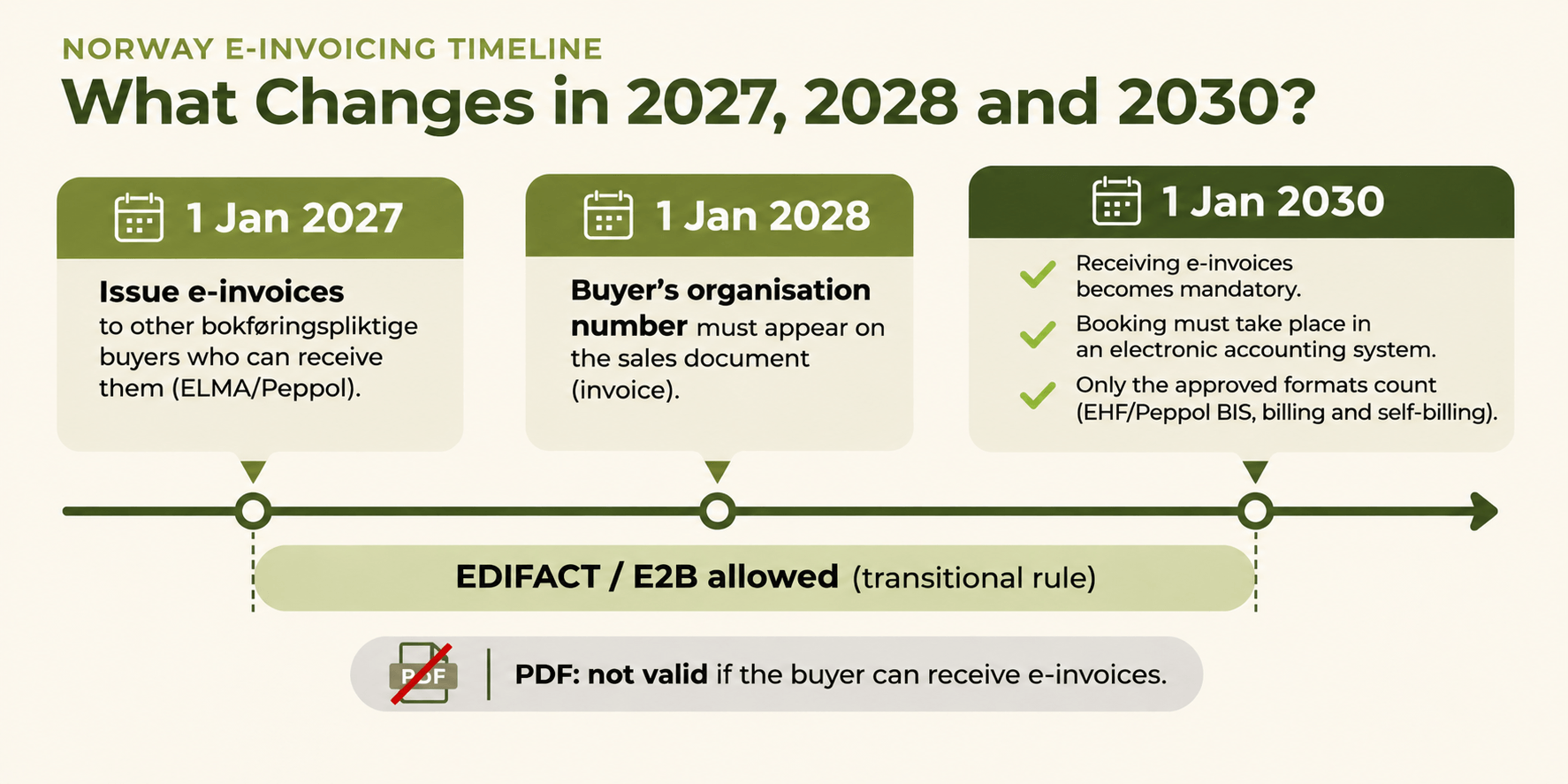
From 1 January 2027, bokføringspliktige must issue electronic invoices when selling goods and services to other bokføringspliktige (bokføringsloven § 10 annet ledd første punktum). The duty to receive electronic invoices starts on 1 January 2030.
The obligation has a practical limit until then. Until 1 January 2030, the issuing duty only applies in practice when the bokføringspliktig buyer can receive e-invoices, meaning it is registered in ELMA/Peppol.
The four approved standards
The approved standards are EHF Fakturering, Peppol BIS Billing, EHF Selvfakturering and Peppol BIS Self-Billing, all in version 3.0 or newer (bokføringsforskriften § 5-2-9 annet ledd). The provision takes effect on 1 January 2027.
Regular invoices and self-billing both have an EHF variant and a Peppol BIS variant, and each one counts. For a country-level overview of the timeline, see our Norway e-invoicing page.
EHF vs Peppol BIS: Same Invoice, Two Names
How the standards fit together
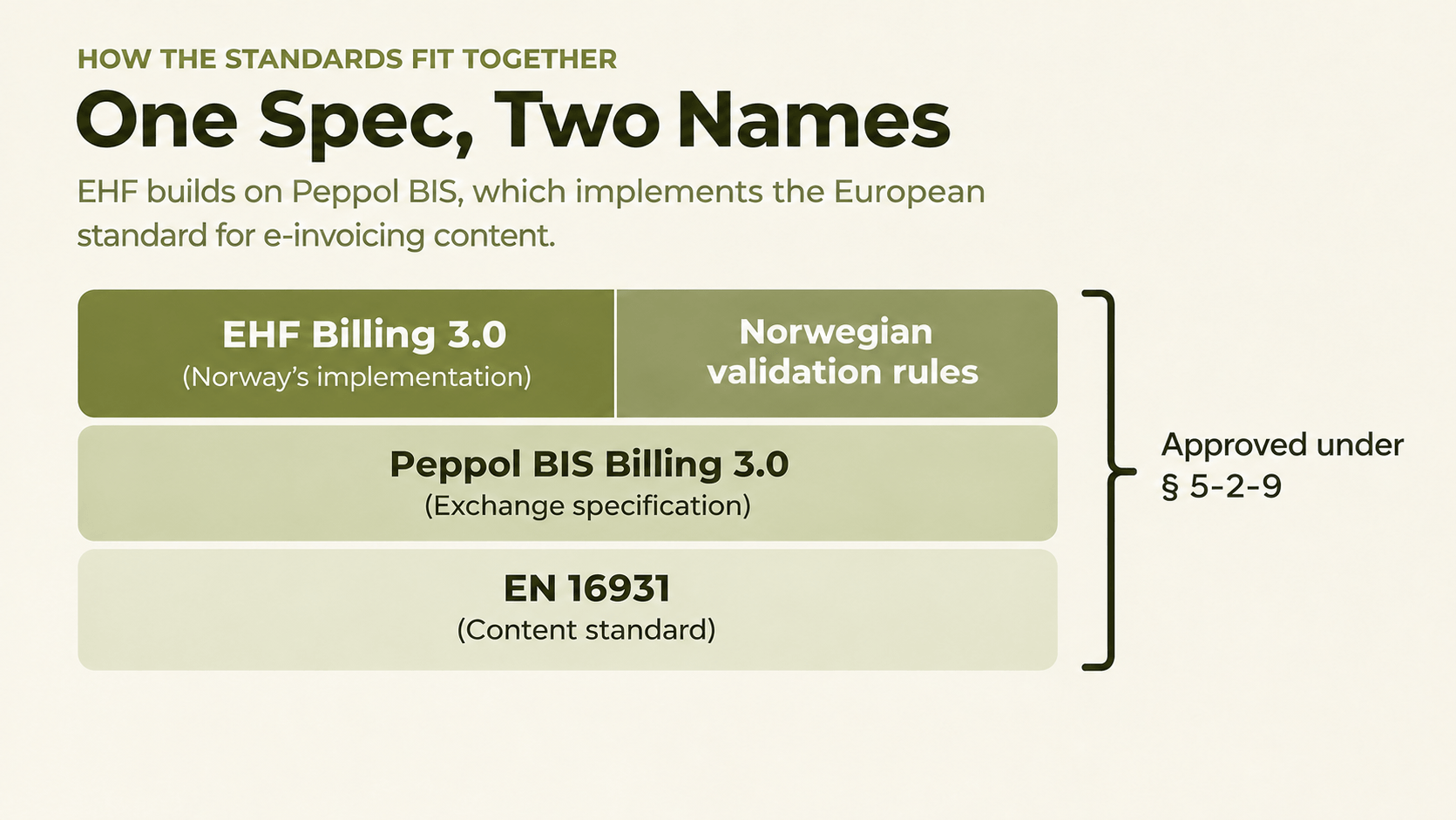
EHF moved to version 3.0 in January 2020. That aligned it with Peppol BIS 3.0, added Norwegian validation rules and retired the legacy EHF2 format.
When the label matters
For a Nordic group, the practical difference is validation. An invoice that passes generic Peppol BIS rules can still fail Norwegian-specific checks. Sending to a Norwegian buyer is therefore not only a format question: your Access Point also has to validate against the right rule set. HubBroker's Peppol Access Point handles BIS and country-level validation before an invoice leaves your ERP.
What Changes on 1 January 2027, and What Waits Until 2030
The buyer triggers the obligation
From 2027, the question is whether your buyer can receive e-invoices. Skatteetaten is explicit that if the buyer requires an e-invoice in EHF/Peppol BIS Billing format, you must send it in that format.
EDIFACT and E2B get a transition period. PDF does not.
Until 1 January 2030, a transitional rule allows electronic invoice formats other than those listed in § 5-2-9 annet ledd. These formats must still meet the definition in bokføringsloven § 3 nr. 3: a structured electronic format suitable for automated processing in the accounting system.
Skatteetaten names EDIFACT and E2B as examples. A PDF invoice does not meet that definition. It cannot be used if the bokføringspliktig buyer can receive electronic invoices.
If you exchange EDIFACT invoices with large Norwegian trading partners today, those flows can continue for now, but they need a migration plan before 2030. HubBroker's EDI integration platform runs EDIFACT and Peppol side by side, so you can move partners across one at a time.
2028 and 2030 milestones
From 1 January 2028, the bokføringspliktig buyer's organisation number must appear on the sales document (bokføringsforskriften § 5-1-2 første ledd). From 1 January 2030, bookkeeping must take place in an electronic accounting system (bokføringsloven § 7 fjerde ledd), and every bokføringspliktig business must be able to receive e-invoices.
Who Is Exempt
Exemptions from the duty to send and/or receive electronic invoices are set out in bokføringsforskriften:
§ 1-1: bankruptcy estates
§ 1-2: low turnover
§ 8-13-2: financial undertakings
§ 8-14-2: insurance companies and pension undertakings
The low-turnover exemption has detailed conditions, so check § 1-2 directly rather than assuming you qualify.
What This Means for Your ERP
Most Nordic ERPs can produce some form of EHF. The gaps usually sit elsewhere. Check these four points:
Format output. Confirm your ERP or Access Point produces EHF/Peppol BIS Billing 3.0, and self-billing documents if you use them.
Buyer lookup. Check receiving capability before each send, not once a year.
EDIFACT partners. List every Norwegian partner on EDIFACT or E2B and set a migration date before 2030.
Master data. Make sure buyer organisation numbers are complete before 2028.
None of this requires a new ERP. HubBroker works as an integration layer on top of Business Central, Dynamics 365 F&O, SAP Business One, e-conomic and Uniconta. It adds Peppol output, validation and partner routing to the system you already run.
FAQ
Is EHF the same as Peppol BIS?
In practice, yes. EHF Billing 3.0 follows Peppol BIS Billing 3.0 and adds Norwegian validation rules. Both are approved under bokføringsforskriften § 5-2-9.
Can I still send EDIFACT invoices to Norwegian customers after 2027?
Yes, until 1 January 2030 under the transitional rule, provided the format is structured and suitable for automated processing.
Is a PDF invoice valid in Norway after January 2027?
Not if the bokføringspliktig buyer can receive electronic invoices.
Do I need to receive EHF from 2027?
No. The receiving duty starts on 1 January 2030.
Which format should foreign suppliers use?
Peppol BIS Billing 3.0 through a Peppol Access Point is the common route. Check how the rules apply to any Norwegian entity or VAT registration you have.
Not sure whether your current invoice output meets the four approved standards? HubBroker can review your setup against the 2027 rules, with no change to your ERP required.
