
EDI vs API Integration: Which One Does Your Trading Partner Actually Need?
The onboarding email usually arrives with a deadline attached. A new retail customer wants your orders and invoices "on EDI". A marketplace hands you API documentation and a sandbox key. A public-sector buyer asks for your Peppol ID.
Your team now has to decide what to build, and how much effort it will take. The good news is that the EDI vs API integration question is rarely yours to answer alone. In most cases, your trading partner has already made the choice. Your job is to recognise what they are asking for and connect it to your ERP without rebuilding everything for each new partner.
EDI vs API Integration in Plain Terms
Both approaches move business data between companies without manual re-keying. They differ in how that data is structured, sent and confirmed.
What EDI Does
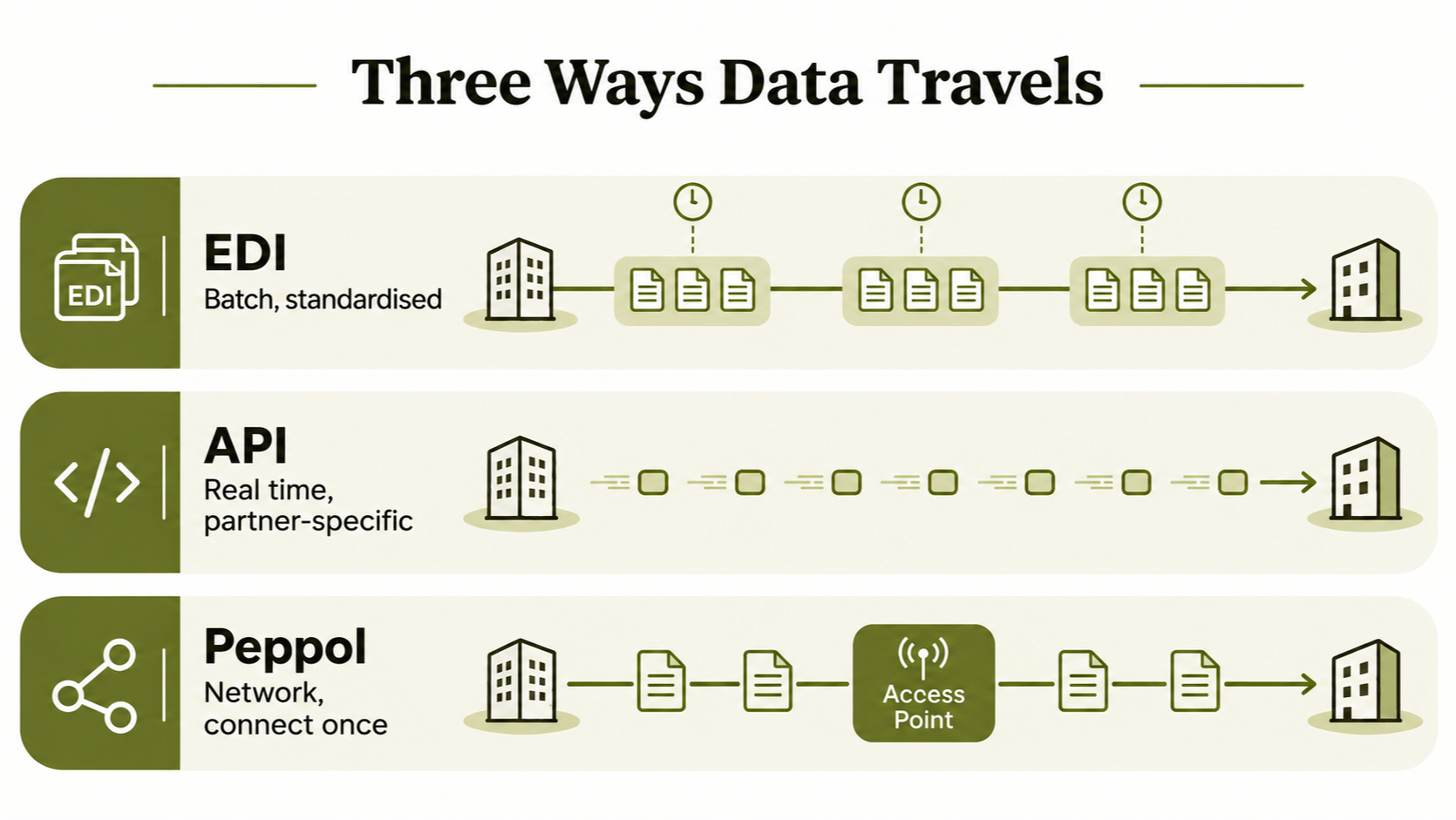
Electronic Data Interchange exchanges business documents in agreed, standardised formats such as UN/EDIFACT or ANSI X12. A purchase order, order response, despatch advice or invoice follows a fixed message structure that both sides understand.
Documents typically travel in batches over secured channels such as AS2, SFTP or a VAN, and the receiver returns acknowledgements to confirm delivery. EDI suits high-volume, repeatable document flows where both sides value stability over speed. HubBroker's EDI integration covers this full order-to-invoice flow.
What API Integration Does
An API (Application Programming Interface) lets two systems talk directly, usually through REST calls with JSON payloads. Instead of sending a complete document file, your system requests or pushes specific data: a new order, a stock level, a shipment status.
API integration works in near real time and fits platforms that change quickly. The trade-off is that every API is different. Each partner defines its own endpoints, authentication, data model and rate limits, so each connection needs its own mapping. See how ERP API integration handles this between your ERP and external platforms.
Where Peppol Fits
Peppol is neither classic EDI nor a custom API. It is an international network in which certified Access Points exchange standardised business documents, mainly e-invoices and credit notes, but also orders and despatch advice where supported.
You connect once through an Access Point and can then reach any registered participant. That makes Peppol a third option you will meet more often as e-invoicing mandates spread across Europe.
Why Your Trading Partner Usually Makes the Decision
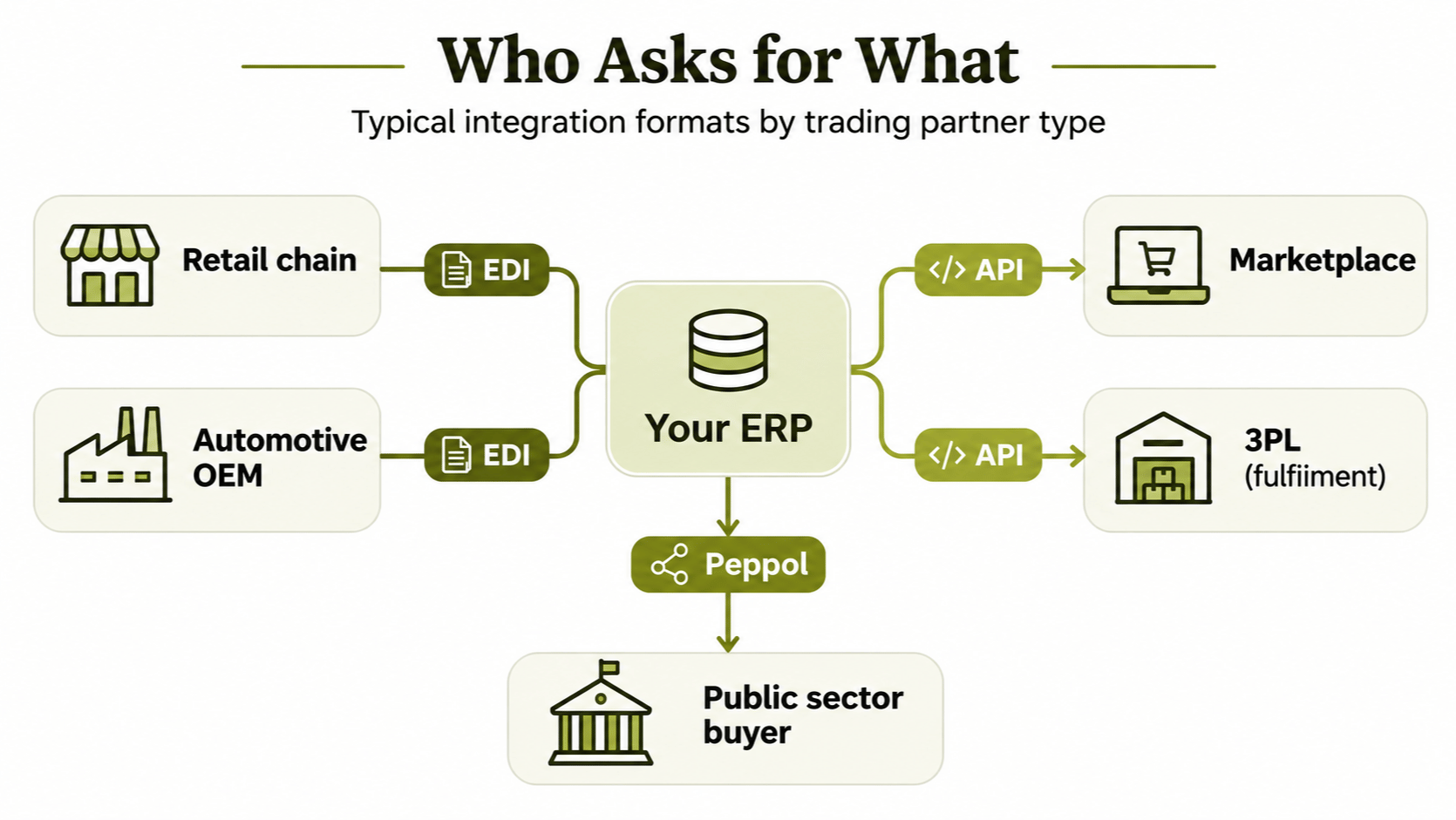
Integration format follows market power. The larger partner sets the requirement, and suppliers adapt. Knowing the typical pattern by partner type helps you predict the request before it arrives.
Large Retailers, Automotive and Logistics
Established retail chains, automotive manufacturers and logistics providers have run EDI for decades. Their supplier onboarding programmes, compliance rules and penalties for late or incorrect documents are built around EDI messages. If you supply them, expect EDI as a condition of doing business.
Marketplaces, SaaS Platforms and Modern 3PLs
Online marketplaces, eCommerce platforms and newer fulfilment providers are usually API-first. They publish developer documentation and expect you to pull orders and push stock, shipping and tracking data through their APIs. Some, such as Amazon, run both models: EDI for vendors selling wholesale and APIs for sellers listing their own products. HubBroker's trading partner connections show how these marketplace flows link to your ERP.
Public Sector and Mandated E-Invoicing
Public buyers across Europe increasingly require structured e-invoices, and several countries now extend this to B2B invoicing. Where Peppol is the chosen network, a PDF attached to an email no longer meets the requirement. A Peppol e-invoicing connection lets you send and receive these documents directly from your ERP.
EDI vs API Integration Side by Side
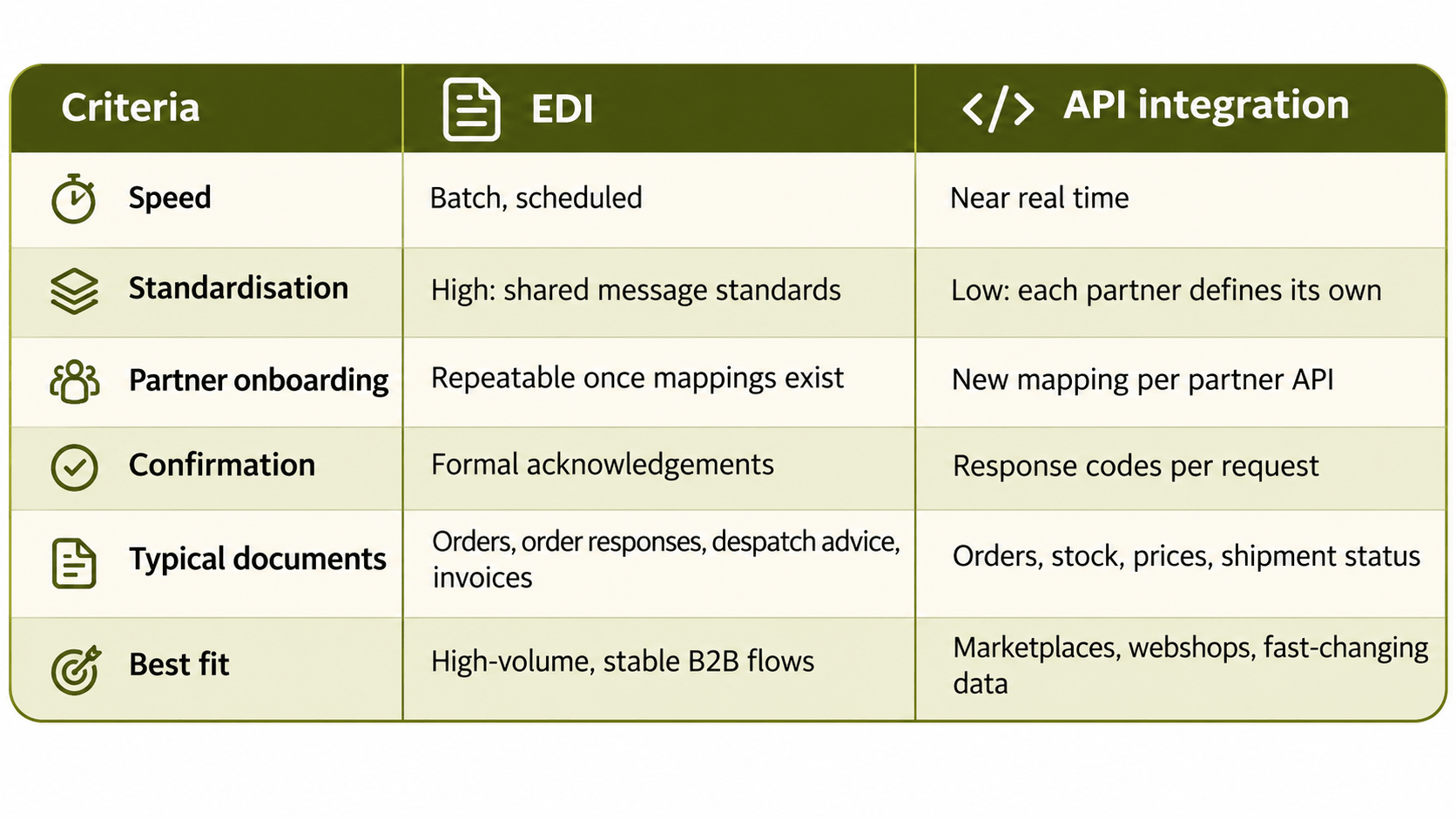
Neither column wins outright. The right choice depends on the partner, the document and the volume.
Five Questions to Ask Before You Build Anything
Which documents are involved? Orders and invoices often point to EDI or Peppol. Stock and tracking updates often point to an API.
What volume do you expect? Thousands of order lines per day favour a stable, standardised flow.
How fast must data move? If a partner needs stock levels every few minutes, batch EDI will not keep up.
What does the partner's specification say? Ask for their implementation guide before quoting effort. It settles most debates.
How many partners are coming next? One partner can justify a direct connection. Ten partners call for a reusable setup.
When You Need Both (and You Probably Will)
Few businesses deal with a single type of trading partner. A typical distributor might supply a retail chain over EDI, sell through a marketplace via API and invoice public customers over Peppol, all from the same ERP.
Treating each connection as a separate project creates a patchwork of point-to-point integrations, each with its own monitoring, error handling and maintenance. When one partner changes its specification, your team has to find out which piece broke and why.
The more useful question is therefore not EDI vs API integration, but how to support both without multiplying complexity.
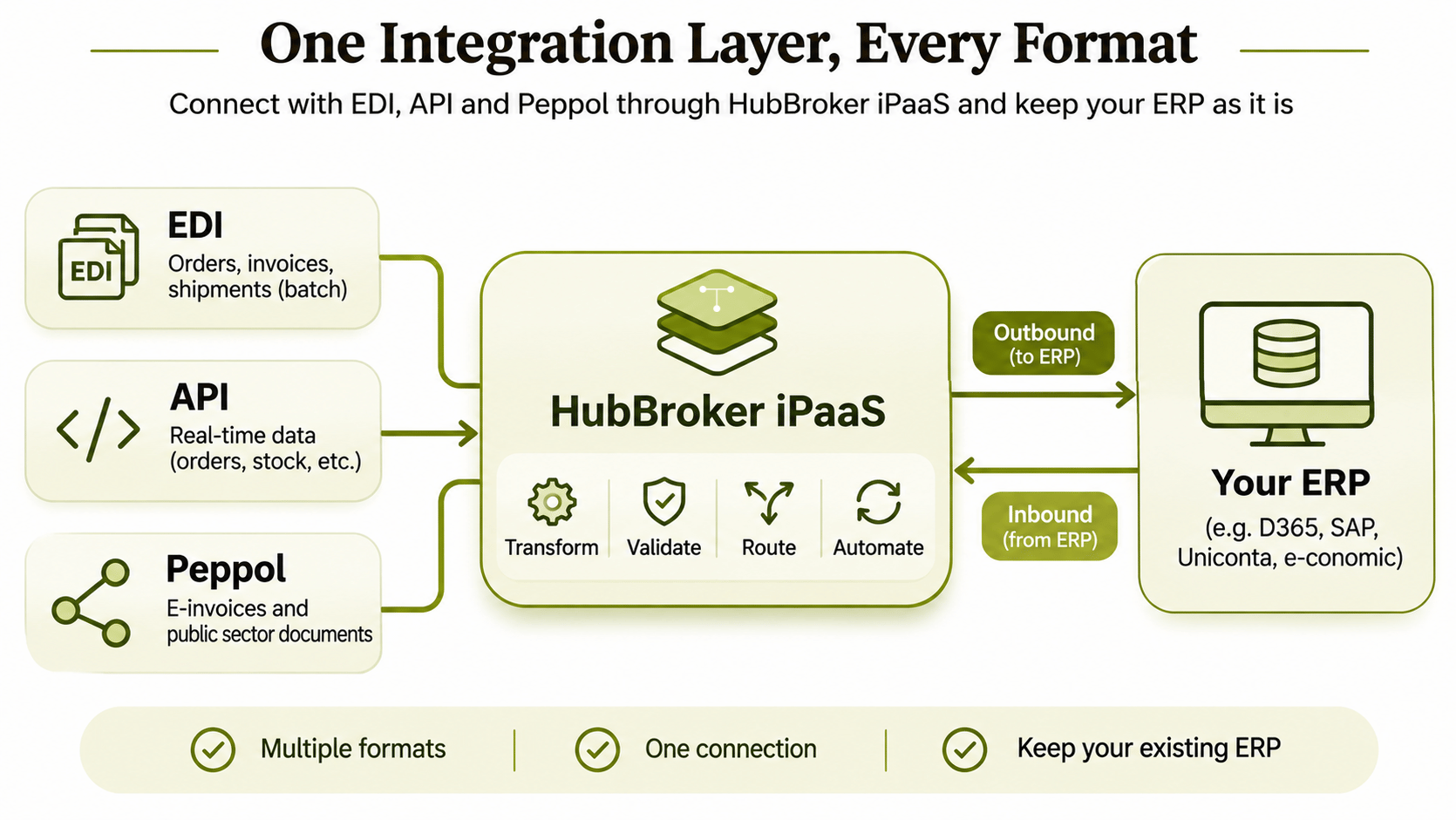
One Integration Layer, Every Format
HubBroker iPaaS sits on top of your existing ERP, whether that is Microsoft Dynamics 365 Business Central, Microsoft Dynamics 365 Finance & Operations, SAP Business One, Visma e-conomic or another system. It does not replace it.
Your ERP sends and receives data in one consistent structure. HubBroker iPaaS translates it into whatever each partner requires: EDIFACT for the retail chain, API calls for the marketplace and Peppol documents for public buyers. Mappings, partner profiles and validation rules are reusable, so the next partner builds on work already done.
All inbound and outbound documents are monitored in one place. When something fails, your team sees which document, which partner and which rule, without searching through separate tools.
Frequently Asked Questions
Is EDI being replaced by APIs?
Not in the near term. APIs are growing fast, especially in eCommerce, but EDI remains embedded in retail, manufacturing and logistics supply chains. Most businesses will run both for years.
Can I use an API if my trading partner requires EDI?
Your ERP can, through an integration layer. The layer receives data from your ERP via API or file, converts it into the partner's EDI format and handles transport and acknowledgements. Your partner receives the EDI messages it requires.
Is Peppol a type of EDI?
Peppol shares EDI's principle of standardised, structured documents, but it is a distinct network with its own document specifications, Access Points and participant directory. It is best treated as a separate channel alongside EDI and APIs.
How long does EDI onboarding take?
It depends on the partner's specification, the number of document types, your ERP data quality and the partner's testing schedule. Reusing existing mappings and partner profiles shortens each new onboarding.
Do I need to change my ERP to support EDI and APIs?
No. An integration layer connects to your existing ERP and handles format conversion, transport and validation outside it, so your internal processes stay unchanged.
Map Your Trading Partners' Requirements
If you are facing a new partner requirement, or already juggling EDI, APIs and Peppol separately, it helps to see the whole picture first. Book a 30-minute demo and we will walk through your trading partners' formats and how they connect to your ERP.
