
Brazil E-Invoicing Software What Enterprises Need for Scalable Invoice Automation
A company processing a small number of Brazilian invoices may still manage errors and exceptions manually. But this becomes difficult once invoice volumes grow across different ERP systems, legal entities, customers and fiscal-document types.
Because of this, Brazil einvoicing software needs to do more than only create a compliant invoice. Enterprises need an integration setup that validates fiscal data, manages authority responses, handles errors, sends status back into ERP and can adjust when Brazilian technical requirements change.
What Is Brazil E-Invoicing Software?
Brazil e-invoicing software connects ERP and other business systems with the electronic fiscal-document processes required in Brazil.For NF-e, the process normally includes preparing structured XML data, applying the required fiscal rules, sending the document through the relevant authorization process, receiving the authority response and returning final status to the source system. Brazil also uses other electronic fiscal documents.
These include NFS-e for service invoices and NFC-e for consumer transactions. Each document type can follow different business and technical requirements, so enterprise software should support the correct workflow instead of treating every Brazilian invoice in exactly same way. The goal is not just document creation. The complete process needs to stay visible and manageable for Finance and IT.
How Does NF-e Integration Work With an ERP?
A scalable NF-e integration should automate both invoice data and processing status between the ERP and the Brazilian fiscal process.
A typical flow may look like:
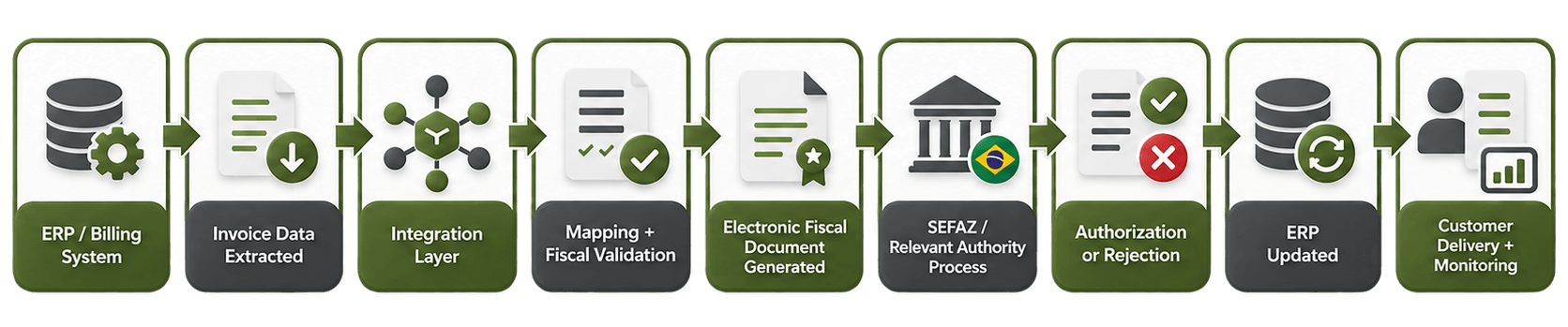
The ERP normally remains the main source for customer, product, tax and invoice information. The integration layer takes this information, maps it into the correct structure, validates important fields and sends it to the required fiscal process. Once the document is authorized or rejected, that response should come back into ERP or the monitoring system.
The NF-e Portal continues to publish XML schemas and technical-note packages. This is one reason integrations need proper version and change management instead of using one fixed mapping forever. For NFS-e, Brazil’s national environment also provides API documentation and production schemas. Government technical material includes contributor APIs and XSD files, while API issuance requires the required credentials and technical setup.
What Should Enterprises Look for in Brazil E-Invoicing Software?
For larger businesses, scalability is mostly an operational and architecture issue. The platform should handle higher transaction volumes without making Finance or IT manually investigate every invoice.
Enterprise Requirement | Why It Matters | Software Capability |
|---|---|---|
High invoice volume | Manual control becomes difficult | Automated processing |
Multiple ERPs | Data structures are different | Flexible mapping |
Multiple entities | Configurations can vary | Central configuration |
Validation | Incorrect data creates failures | Pre-submission checks |
Authority responses | ERP needs latest status | Status return |
Exceptions | Failures need action | Error workflow |
Regulatory change | Technical requirements change | Central maintenance |
Multi-ERP connectivity becomes especially important for enterprise groups. A company may use SAP in one entity, Microsoft Dynamics or Business Central in another, while ecommerce or custom applications send other transaction data. A common integration layer can map these different source structures into controlled fiscal workflows.
This avoids rebuilding the complete Brazil invoice process separately for every ERP connection.
Can Brazil E-Invoicing Be Fully Automated?
Large parts of the process can be automated, but good automation still depends on correct data and clear exception handling. Software can extract ERP information, apply mappings, validate required data, transmit fiscal documents, receive responses, update ERP status and route failed documents for review.
The difficult part is often not the normal invoice. It is the exception. A scalable solution should clearly separate a business or data problem from a technical failure. Missing fiscal information, incorrect customer details, invalid tax data or mapping issues normally need somebody to correct the source information. Temporary connectivity or transmission problems may instead support automatic and controlled retries.
The process should remain clear:
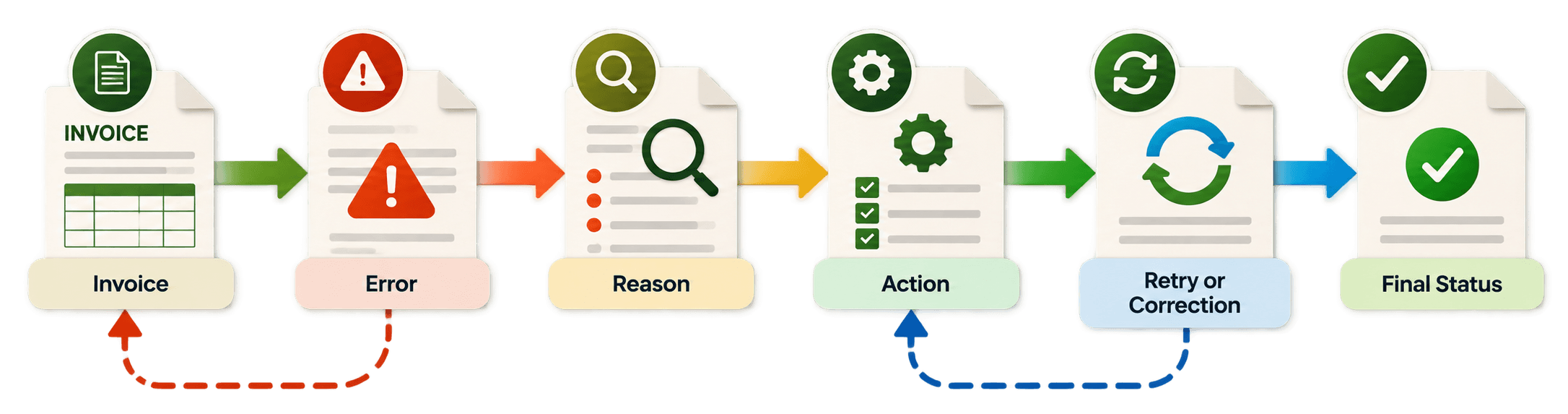
This is important because automation at high volume can easily turn into a large manual support queue if failures are not designed properly.
Direct ERP Integration or an Integration Layer?
A direct ERP connection can work well when a company has one ERP, lower transaction volume, limited fiscal-document types and only few transformation requirements. The situation changes when the business has multiple ERPs, legal entities, countries, EDI connections, APIs, ecommerce platforms or complex validation rules. In those situations, an integration layer can provide more central control.
Instead of each ERP maintaining its own mappings, monitoring and external connections, common logic can be managed through one integration platform. Central mappings and monitoring also make technical updates easier to control. When a schema, authority requirement or external API changes, the company may be able to update the integration layer instead of rebuilding every ERP interface separately. The architecture should support the wider enterprise document environment, not only the first Brazil invoice connection.
What Should Enterprises Ask a Brazil E-Invoicing Vendor?
Before selecting software, companies should ask which Brazilian fiscal documents are actually supported. They should also check which ERP systems can connect, how mappings are created and maintained, how validations work, and how authorization or rejection responses return back to ERP.
Error handling is also important.
✔ Ask what happens when an invoice fails. Can users see the reason?
✔ Can failed transactions be corrected and retried? Is there a history of previous attempts?
Enterprises should also confirm whether several legal entities can be managed from the same platform and whether monitoring gives clear transaction visibility.
Regulatory and schema updates need another question:
✔ who maintains them and how quickly can changes be applied?
For NFS-e, companies should confirm which national or applicable local process applies to their own operations. They should not assume that one service-invoice setup works for every municipality, entity or business case. Brazil’s NFS-e documentation continues to publish APIs, layouts and schemas, so flexibility remains important.
How Can HubBroker Support Brazil E-Invoicing Automation?
HubBroker can work as an integration and automation layer between enterprise systems and electronic invoicing processes.
Supported capabilities can include ERP and API integration, EDI, data mapping, transformation, validation, workflow automation, status handling, error management, monitoring and multi-country connectivity.
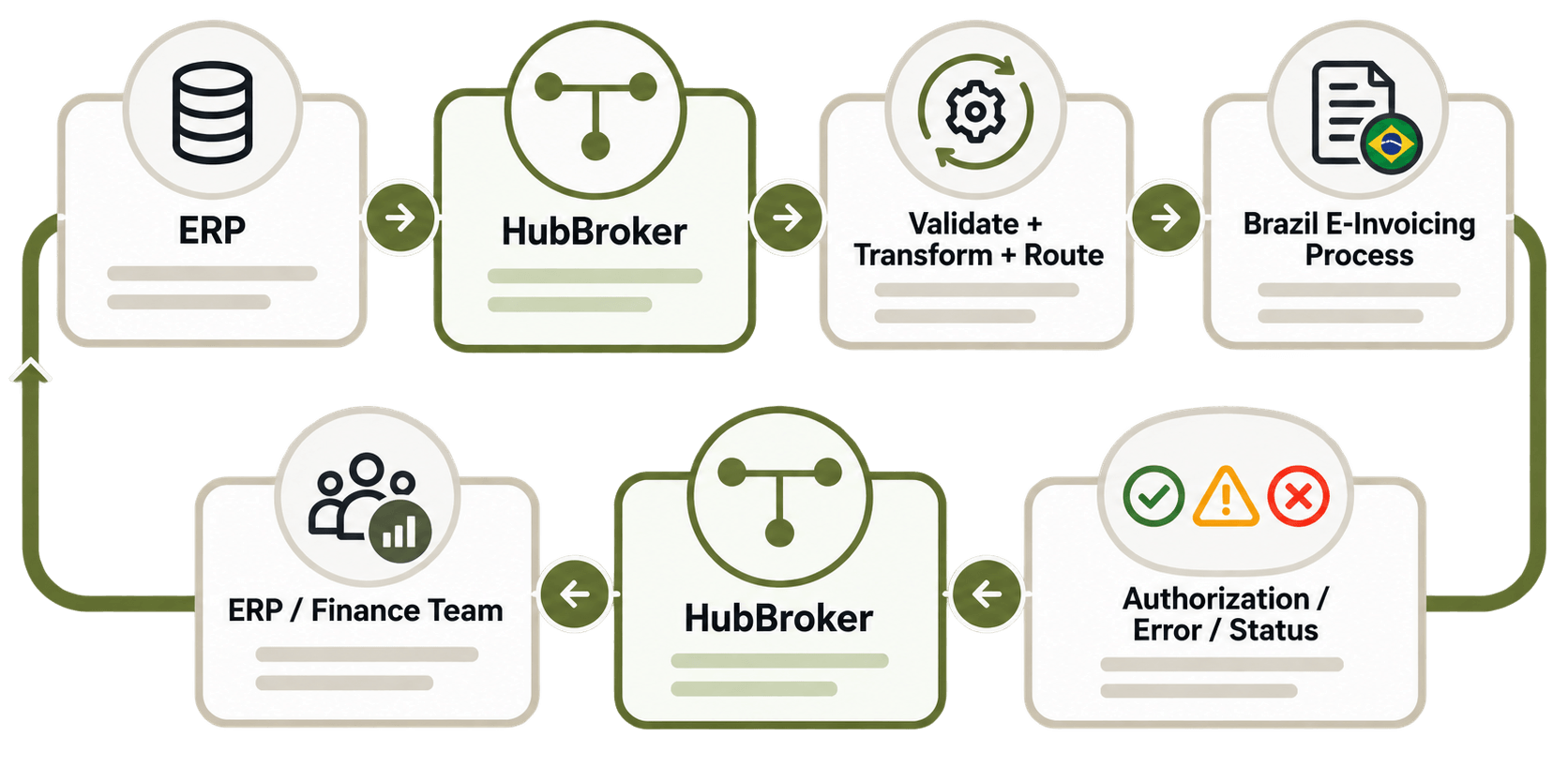
A controlled setup can follow this model:
This gives Finance and IT one controlled process for invoice creation, validation, authority communication and status tracking.
If your company is scaling electronic invoicing in Brazil,
👉 HubBroker can help connect ERP data with transformation, validation, monitoring, status handling and document workflows.
👉 Talk to our team about your Brazil e-invoicing requirements and current ERP setup.
