
The Hidden Benefits of EDI in E-commerce: Faster Orders, Fewer Errors, Happier Customers
Why Growing E-commerce Businesses Need EDI Before Manual Processes Start Costing Too Much
E-commerce growth looks exciting from the outside.
More orders. More customers. More sales channels. More suppliers. More delivery partners.
But behind the scenes, growth can quickly turn into operational pressure. Someone has to enter order data into the ERP. Someone has to check invoices. Someone has to update stock levels. Someone has to send shipping information to the right partner at the right time.
At low volume, manual work may feel manageable. But as order volume increases, small mistakes become expensive. That is where EDI in e-commerce becomes valuable.
EDI, or Electronic Data Interchange, helps e-commerce businesses exchange orders, invoices, shipping notices, inventory updates, and other business documents automatically between systems. Instead of relying on emails, spreadsheets, portals, and manual data entry, EDI allows structured data to move directly between your e-commerce platform, ERP, suppliers, warehouses, and trading partners.
What Is EDI in E-commerce?
EDI in e-commerce is the automated exchange of structured business documents between different systems and trading partners.
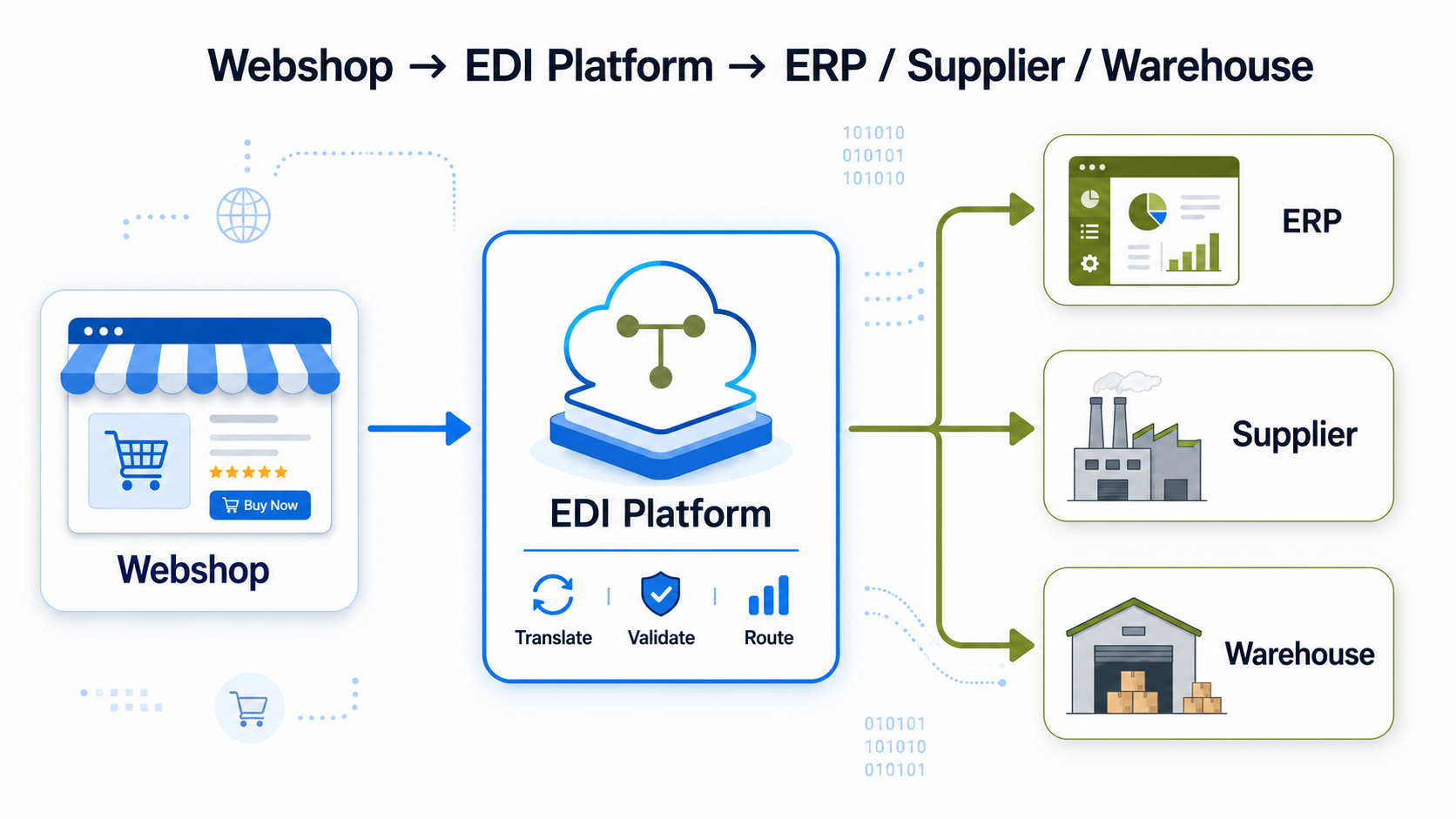
For example, when a customer places an order on a webshop, that order can move automatically to the ERP. The ERP can send order details to a warehouse. The warehouse can send back a shipping notice. The invoice can then be generated and exchanged without someone manually copying data from one place to another.
Common EDI documents in e-commerce include:
Purchase orders
Order confirmations
Invoices
Shipping notices
Delivery notes
Inventory updates
Payment-related documents
In simple terms, EDI helps your business systems “speak” to each other in a structured way.
Why Manual E-commerce Processes Become a Problem
Manual processing usually starts small.
A team copies orders from a webshop into an ERP. Supplier updates arrive by email. Invoices are checked manually. Shipping updates are entered into portals. Inventory is updated after someone exports and imports a file.
This can work for a while. But once the business grows, the risks grow too.
Manual work can lead to:
Incorrect product codes
Wrong quantities
Delayed invoices
Missed shipping updates
Duplicate order entries
Slow customer response
Poor stock visibility
Higher back-office costs
For CFOs, this means more operational cost and more room for financial errors. For IT managers, it means more disconnected systems and manual workarounds. For finance directors, it means more invoice disputes, reconciliation delays, and reporting issues.
Unlock the Benefits of EDI in E-Commerce
Automate order, invoice, and shipment data exchange to reduce errors, speed up fulfillment, and improve partner communication with HubBroker’s EDI integration solutions.
Contact Us to Know More
What Are the Main Benefits of EDI in E-commerce?
1. Faster Order Processing
Speed matters in e-commerce.
Customers expect quick confirmations, fast fulfilment, and accurate delivery updates. When orders are handled manually, every extra step creates delay.
EDI helps orders move automatically from the webshop or marketplace into the ERP, warehouse, or supplier system. This reduces waiting time and allows teams to process more orders without increasing manual effort.
For growing e-commerce companies, this can make a major difference during seasonal peaks, campaign periods, or marketplace sales events.
2. Fewer Data Entry Errors
Manual data entry is one of the easiest ways for mistakes to enter your operation.
A wrong quantity, incorrect SKU, missing address detail, or pricing mismatch can create bigger problems later. Orders may be shipped incorrectly. Invoices may not match. Customers may receive the wrong item.
EDI reduces this risk because data is exchanged directly between systems in a structured format. Teams no longer need to retype the same information into multiple platforms.
The result is cleaner data, fewer corrections, and less time spent fixing avoidable mistakes.
3. Better ERP and E-commerce Platform Integration
Many e-commerce businesses use multiple systems: a webshop, ERP, warehouse management system, accounting tool, supplier portal, and marketplace account.
Without integration, these systems create data silos.
EDI integration helps connect these systems so that order, invoice, inventory, and shipping data can move more smoothly. For example, an order from Shopify, Amazon, Magento, WooCommerce, or another e-commerce channel can be transferred into an ERP such as Microsoft Dynamics 365 Business Central, SAP, Oracle, or another business system.
This is where a solution like HubBroker’s EDI Integration can help businesses create a more connected e-commerce operation.
4. Improved Invoice Accuracy
Invoice problems are not only a finance issue. They affect cash flow, supplier relationships, and internal productivity.
When invoices are created or checked manually, mismatches can happen between the order, delivery, and invoice. Finance teams then spend time investigating what went wrong.
EDI supports more accurate invoice exchange because structured data can be matched against related documents such as purchase orders and delivery notes.
For finance teams, this means:
Fewer invoice disputes
Faster invoice processing
Cleaner reconciliation
Better audit readiness
Improved visibility into transaction data
5. Stronger Supplier and Trading Partner Communication
E-commerce companies often depend on suppliers, distributors, logistics providers, marketplaces, and retailers.
Each partner may have its own document requirements, formats, and processes. Managing all of this manually becomes difficult as the partner network grows.
EDI helps standardize communication with trading partners. Orders, confirmations, invoices, and shipping notices can be exchanged in the required format without relying on scattered emails or manual portal updates.
This makes it easier to work with larger retailers, suppliers, and B2B customers that already expect EDI-based document exchange.
6. Better Inventory and Shipping Visibility
Poor inventory visibility can hurt customer experience.
If your webshop shows stock that is not actually available, you risk overselling. If shipping updates are delayed, customer service teams receive more questions. If warehouse data is not updated in time, fulfilment becomes harder to manage.
EDI can support automated inventory updates, dispatch notices, and delivery information. This helps e-commerce teams keep systems aligned and gives customers more accurate order updates.
7. Lower Operational Costs
EDI does not only save time. It helps reduce the cost of repetitive work.
Instead of hiring more people to copy, check, and correct data, businesses can automate document exchange and allow teams to focus on higher-value work.
For CFOs, this supports cost control. For operations teams, it improves productivity. For IT teams, it reduces the need for fragile manual workarounds.
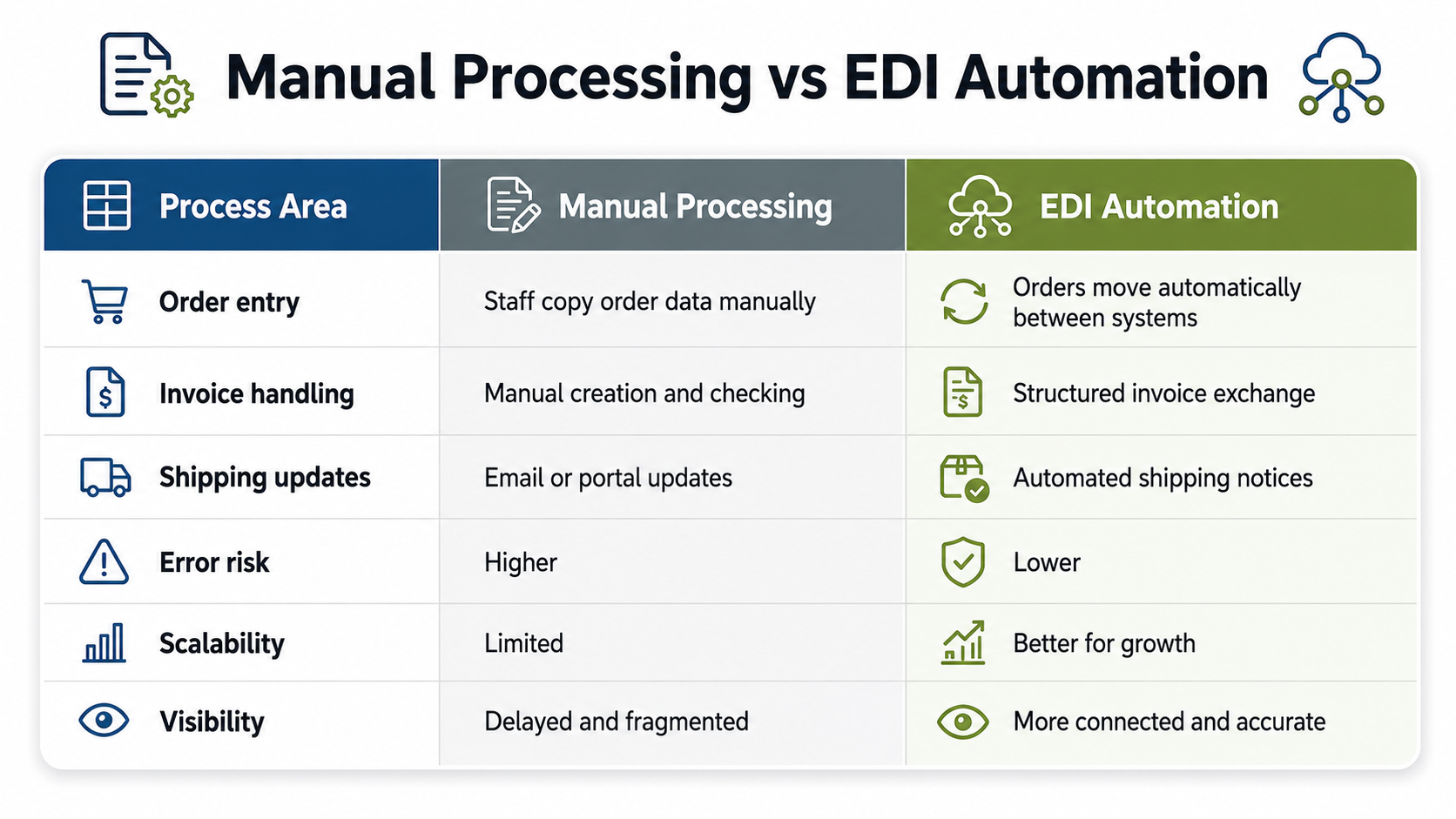
EDI vs Manual Processing: What Changes?
What Should You Check Before Choosing an EDI Solution?
Before choosing an EDI provider, ask these questions:
Can it connect with your ERP?
Can it support your e-commerce platform?
Can it handle your required EDI document types?
Can it connect with multiple trading partners?
Does it offer monitoring and error handling?
Can it scale as order volume grows?
Does the provider understand e-commerce workflows?
A good EDI solution should not only move files. It should support your business process from order to invoice to fulfilment.
How HubBroker Helps E-commerce Businesses with EDI Integration
HubBroker helps e-commerce businesses connect webshops, ERP systems, suppliers, marketplaces, warehouses, and trading partners through automated EDI integration.
With HubBroker, businesses can:
Automate order processing from webshop to ERP
Reduce manual data entry and errors
Speed up invoice exchange and approval
Improve supplier and warehouse communication
Keep order, invoice, and shipping data connected
Scale e-commerce operations without adding extra manual work
Whether you need webshop-to-ERP order sync, invoice automation, supplier document exchange, or marketplace integration, HubBroker helps simplify the flow of business data.
FAQ
What is EDI in e-commerce?
EDI in e-commerce is the automated exchange of business documents such as orders, invoices, shipping notices, and inventory updates between systems and trading partners.
Why is EDI important for e-commerce businesses?
EDI is important because it helps reduce manual work, improve order accuracy, speed up fulfilment, and create better communication between e-commerce platforms, ERPs, suppliers, and warehouses.
Can EDI connect with an ERP system?
Yes. EDI can connect e-commerce platforms with ERP systems to automate order, invoice, inventory, and shipping data exchange.
Is EDI only for large retailers?
No. EDI is also useful for growing e-commerce businesses that are dealing with higher order volumes, multiple suppliers, marketplaces, warehouses, or B2B trading partners.
What documents can be exchanged through EDI?
Common EDI documents include purchase orders, order confirmations, invoices, shipping notices, delivery notes, inventory updates, and payment-related documents.
How does EDI reduce errors?
EDI reduces errors by removing repeated manual data entry. Instead of copying data from one system to another, structured data moves automatically between connected systems.
