

Spain Sets the Clock: B2B E-Invoicing Becomes Mandatory in October 2027 Is Your ERP Ready?
The waiting is over. For four years, Spanish businesses knew mandatory B2B e-invoicing was coming but had no start date. In October 2026 the final ministerial order was published, and the countdown started. Large companies now have less than twelve months to send structured e-invoices to their business customers.
For finance and IT teams, B2B e-invoicing in Spain sits alongside two other obligations: Verifactu and SII. This guide explains what each one requires, who is in scope and what to prepare first.
What Spain's B2B e-invoicing mandate requires
The legal basis
The obligation comes from Article 12 of Ley 18/2022, known as the Crea y Crece law. It was suspended until the implementing regulation arrived: Real Decreto 238/2026 of 25 March 2026, published in the BOE on 31 March 2026 (BOE-A-2026-7295). Orden HAC/1028/2026 then set the technical rules for the public e-invoicing solution and entered into force on 6 October 2026, which triggered the deadlines.
Who is in scope
The mandate covers businesses and self-employed professionals established in Spain when they invoice each other, regardless of invoice amount. Invoices to customers outside Spain are not covered. For foreign groups, this means your Spanish subsidiary is in scope even if headquarters is not. See the Spain e-invoicing country overview for the wider picture, including B2G rules.
Key deadlines for B2B e-invoicing in Spain
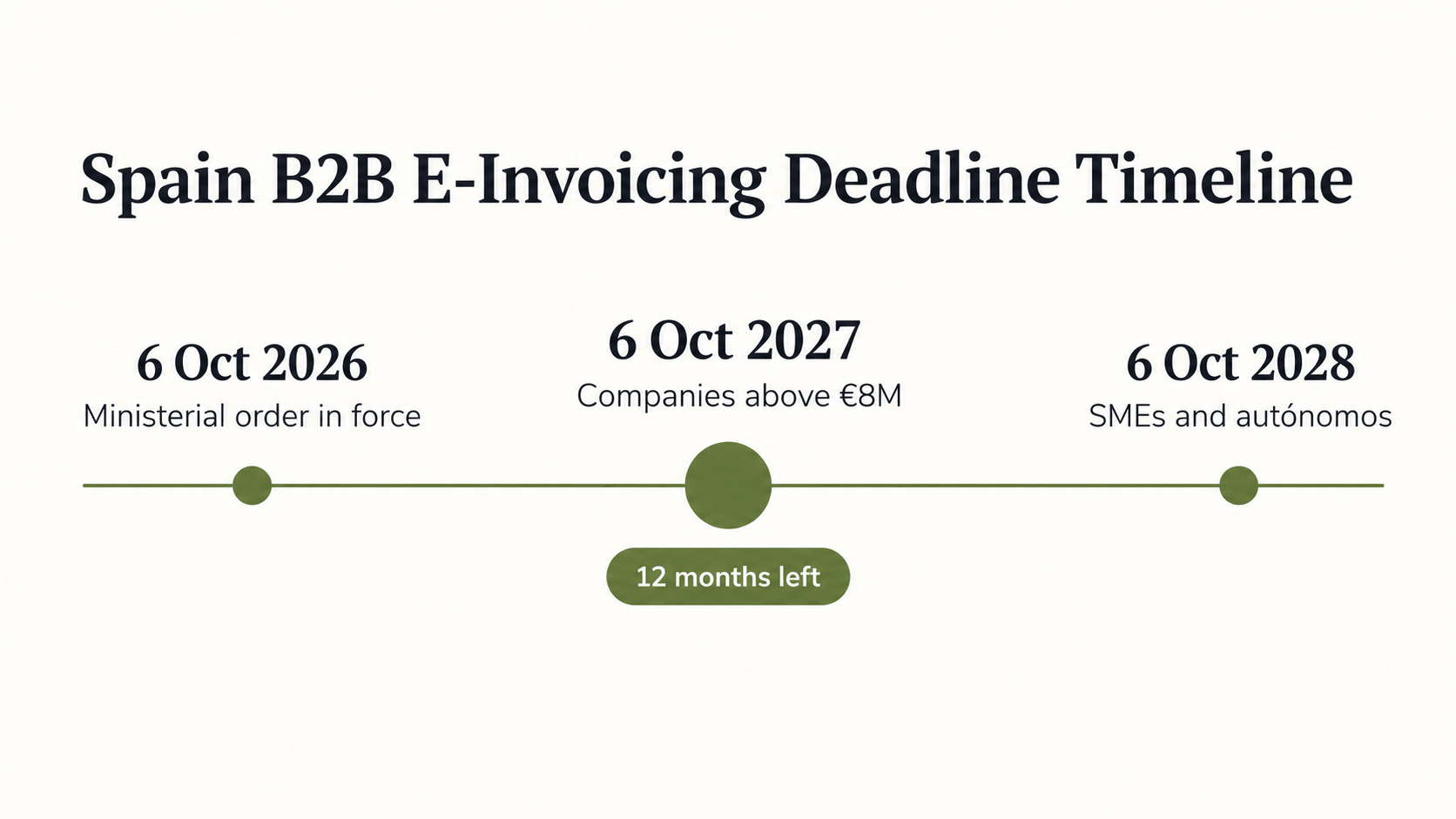
Large companies: 6 October 2027
Businesses with annual turnover above €8 million must issue B2B invoices electronically from 6 October 2027.
SMEs and autónomos: 6 October 2028
All other businesses and self-employed professionals follow from 6 October 2028.
Twelve months is short for an ERP project. Master data clean-up, mapping, testing and partner onboarding all compete for the same people.
Formats, platforms and the hybrid model
Accepted formats
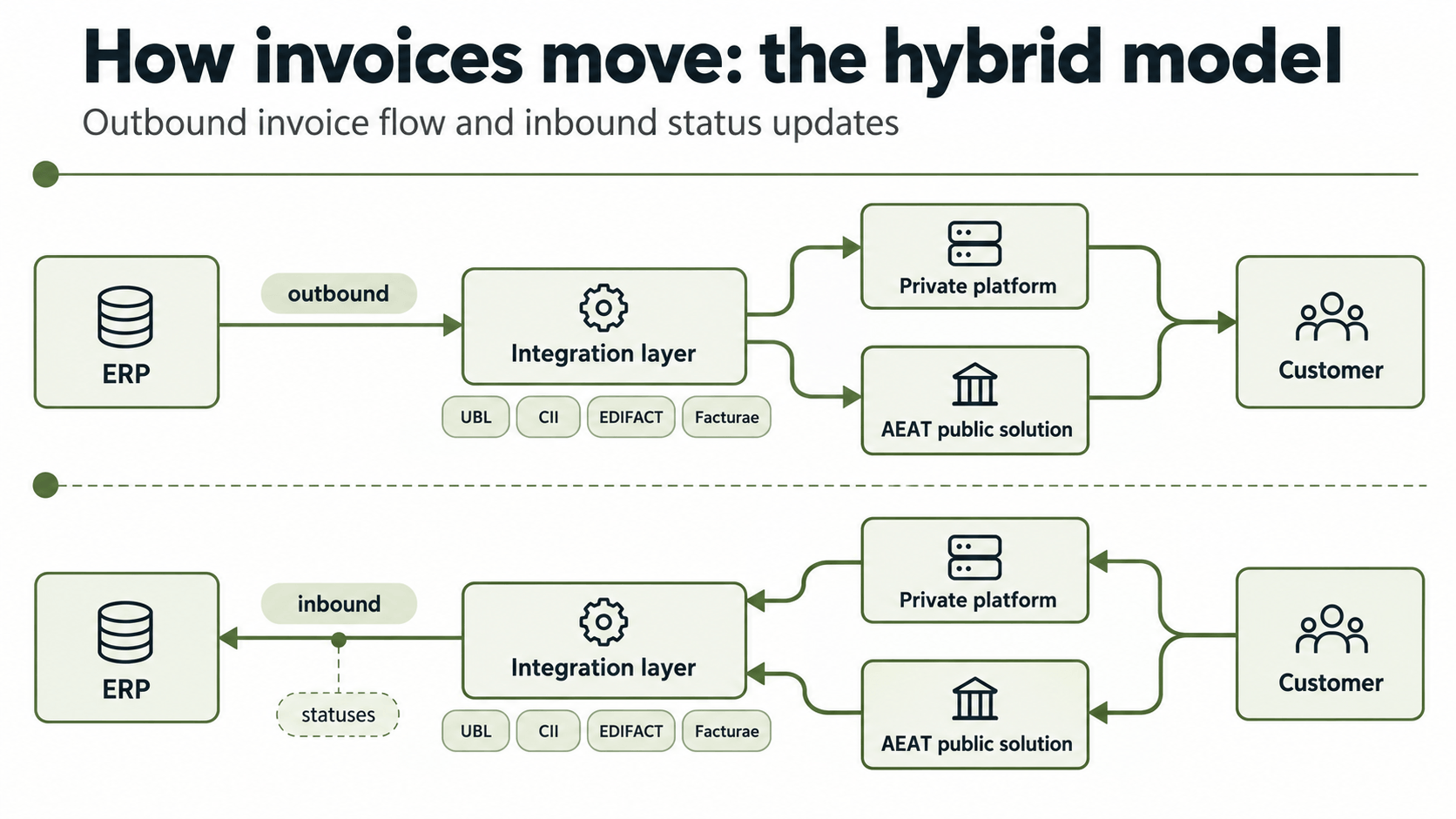
Real Decreto 238/2026 permits four syntaxes: UBL, UN/CEFACT CII, the EDIFACT invoice message and Facturae, Spain's national XML format used for public-sector invoicing. Under Article 7.1, Peppol BIS messages are valid where they use UBL syntax.
Private platforms and the AEAT public solution
Spain uses a hybrid model. Businesses can exchange invoices through private e-invoicing platforms or use a public solution operated by the Agencia Estatal de Administración Tributaria (AEAT).
In practice, most companies will not choose a format once. Each customer or platform may expect a different one, so the real work is converting one ERP invoice into several structures and validating each before it leaves. That is the role of a dedicated e-invoicing solution connected to your ERP.
Invoice status reporting: the late-payment angle
Crea y Crece is also a late-payment law. Beyond exchanging the invoice, recipients must report invoice statuses, such as acceptance, rejection and payment. This gives the tax authority real data on payment times.
For accounts payable, this changes daily work. Inbound invoices must be accepted or rejected in a structured way, and payment events must flow back from the ERP, not from a spreadsheet.
Crea y Crece vs Verifactu vs SII: three different obligations
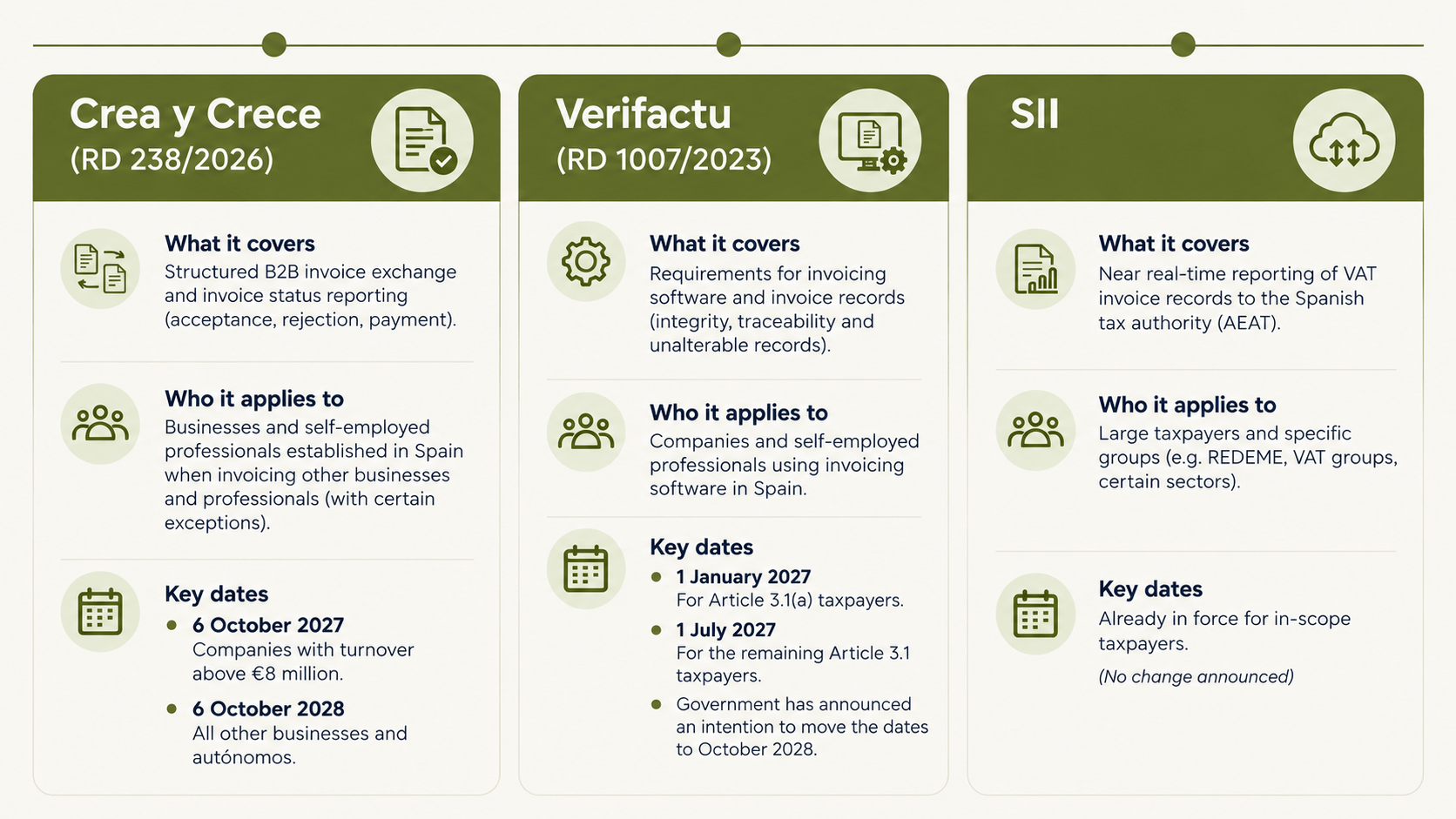
The government has announced its intention to move Verifactu to a later date, aligned with the e-invoicing calendar. Until that change is published in the BOE, the 2027 dates remain the binding ones. Complying with one obligation does not exempt you from the others.
What finance and IT teams should do now
Preparing for B2B e-invoicing in Spain starts with data, not software.
Map your entities. List every legal entity established in Spain and its turnover band to confirm whether 2027 or 2028 applies.
Review ERP invoice data. Tax IDs, buyer identifiers and mandatory fields cause more rejections than technical connections.
Choose your exchange route. Decide between private platforms, the AEAT public solution or a combination.
Plan inbound and outbound flows together. Sending invoices is half the job. Receiving, accepting and reporting statuses is the other half.
Test with real scenarios. Include credit notes, rejections and failed deliveries, not one successful invoice.
You do not need to replace your ERP. An integration layer can take invoice data from Microsoft Dynamics 365, SAP Business One or another ERP, map it to the required format and return statuses to the ERP. Read more about ERP integration services and the stages in our e-invoicing implementation roadmap.
Frequently asked questions
When does B2B e-invoicing become mandatory in Spain?
From 6 October 2027 for businesses with turnover above €8 million, and from 6 October 2028 for all other businesses and self-employed professionals.
Does it apply to foreign suppliers invoicing Spanish customers?
The mandate covers businesses established in Spain. A foreign company without a Spanish establishment is generally outside scope, but a Spanish subsidiary is in scope.
Is Peppol accepted in Spain?
Yes, Peppol BIS messages are valid where they use UBL syntax, one of the four permitted formats.
Does Verifactu replace B2B e-invoicing?
No. Verifactu sets requirements for invoicing software and records. Crea y Crece governs how B2B invoices are exchanged. Most businesses must meet both.
Is a PDF invoice by email acceptable after the deadline?
No. In-scope B2B invoices must be issued in one of the permitted structured formats.
Ready for Spain's deadline?
If you run an ERP with Spanish entities, start with a data and format review now, while there is time to test. Book a demo to talk through connecting your ERP to Spain's e-invoicing model.
